Wishing everyone a healthy and fulfilling new year!

Congratulations to my friend Lauren Blanchard Zalewski, whose first book released November 30 on the heels of the Thanksgiving holiday when we focus particularly on gratitude A great gift for your teenage boy or to use with your clients. Please check it out, especially during this holiday season!
Read more behind the story of Lauren's book here.

From Lauren:
**Have you ordered your copy of my new book "5-Minute Gratitude Journal for Teen Boys" yet?**
Unlike other GRATITUDE journals on the market, this book contains 120 pages of unique topics designed to help today's teen find inspiration, appreciation, and their personal greatness through gratitude.
Gratitude is a powerful tool for teens dealing with school stress, friend drama, and the pressures of social media. Taking time to focus on the good stuff can boost their self-confidence and help them achieve their goals. This gratitude journal provides easy exercises that will help teen boys commit to gratitude and put them in charge of their life and emotions.
With the release date on November 30, each order helps raise the visibility of my book on Amazon to ensure that it gets into the hands of anyone looking for a way to help the teen in their life feel happier and more motivated.
Thanks for your support!!!
To ORDER your copy, go to: https://amzn.to/3qrig9p
Happy to be presenting an art therapy workshop to the Teen Mental Health Society this weekend! Thanks to Aayushi Kulsunge for inviting me to contribute a small part to this great organization she founded to reach teens with mental health support!
REGISTER HERE

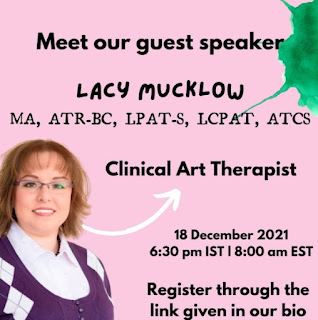
Many thanks to Julie Boyer, Gratitude Guru at #WakeUpwithGratitudePodcast for having me on her show! I am grateful to be your guest, talking about art therapy and more!

Episode #151 – How Does Creating Art Give Us a Way to Deal with Trauma? (Lacy Mucklow)
Have you ever used coloring books for adults? Chances are you might have colored in one of Lacy Mucklow’s books! Lacy is a registered, board certified, and licensed Art Therapist in the Washington, DC area. She’s also the bestselling author of the Color Me Series, including Color Me Grateful. Her books have been translated into more than 15 languages. We talk about what Art Therapy is, how she became an author and why you should never give up on your blog!
Apple podcast: https://podcasts.apple.com/ca/podcast/151-how-does-creating-art-give-us-a-way-to-deal/id1490786349?i=1000540506997
Spotify: https://open.spotify.com/episode/5RxwGyXQ5lOWf6clGpckLQ?si=VJhK9j1gTh6cZ_1Gj6CUzA
It's amazing to see all the artwork submitted for the Healing Arts Exhibit, hosted annually at Walter Reed by the Arts in Health program.
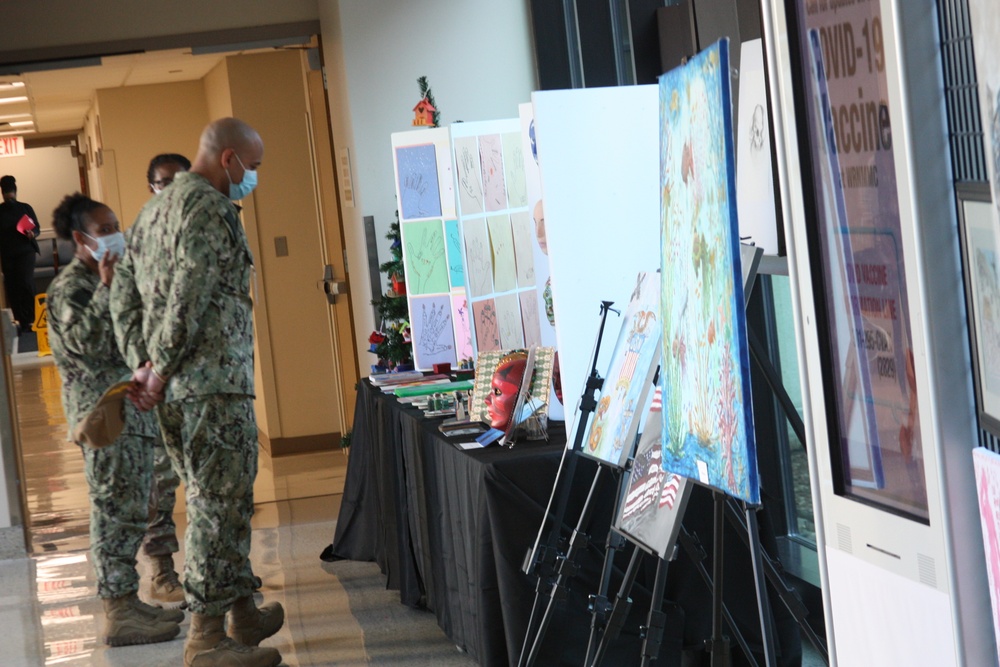
Photo By Bernard Little | Service members look at art included in the Healing Arts Exhibit on display throughout... read more
I'm so happy to be a supervisor for NDMU's graduate art therapy program. My intern Em is a great ambassador for art therapy, and she is a wonderful spokesperson to be featured in the video for their program.
I am still amazed at what has come from the coloring books that I wrote with Angela's illustrations and how global they really became. From what I know, the books have been translated into numerous languages, including the following:
Color Me Calm:
French, German, Korean, French, Arabic, Norwegian, Chinese (Simplified and Complex characters), Bulgarian, Russian, Japanese, Portuguese, Swedish, Spanish, Estonian
Color Me Happy:
Korean, French, Bulgarian, Portuguese, Chinese, Spanish, Swedish, French
Color Me Stress-Free:
French, Chinese, Norwegian, Spanish, Swedish, German
A couple of days ago, I got two boxes from my publishing company with some editions of these translated books. It's hard to describe the feeling to see your words translated into multiple languages around the world.
Please comment on the pictures below if they are in your native language! I would love to hear from you!


This is something that especially applies to art therapy. We talk about it often in session, especially in groups where people tend to compare their creative output with others in the group. Artistic skill is not needed to benefit from art therapy, and we work a lot on not putting value judgments on what they create - for others or themselves. People have all kinds of various experiences, talents, exposure, and interest levels in art, and each piece people create is unique and individualized to them. There is no right or wrong way to create art in an art therapy session, which I do think is harder to internalize in a group setting than an individual setting, though there are plenty of inner critics out there who will fill that role for people in the absence of a group. The art helps you connect to your own self-expression and creativity, and holds meaning for YOU...that is what we focus on in art therapy. It can be an attitude helpful for anyone who creates art as well. It is hard to shift gears from a performance-based society, but it can be done. Feel free to express yourself!


From the embarrassment of being reprimanded to the deep scars from sexual assault, art therapy can help people heal. And you don’t need to be a Picasso to benefit from it.
Christy Yip
@ChristyYipCNA
26 Sep 2021 06:15AM
(Updated: 28 Sep 2021 07:44PM)
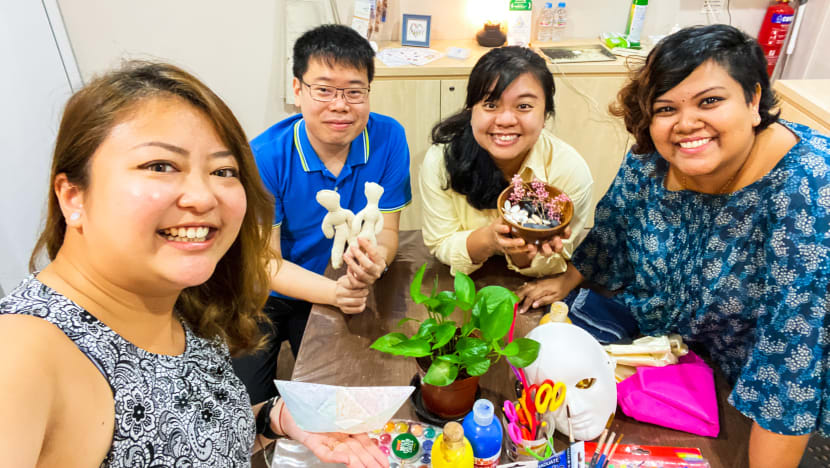
SINGAPORE: When Deanna (not her real name) first started going for art therapy last year, it was to heal from a bad patch at work and pandemic-related stress. But the sessions also uncovered some hurts she thought she'd recovered from: A bad breakup from nine years ago.
“In those nine years, I’ve been in two other relationships,” she said. “To me and to everyone else around me, I’d moved on already.” Yet, one directive during her session — to draw someone standing in the rain — triggered memories of the fiance who cheated on her. Never mind that it was only a “stickman” that she had drawn.
“It was a very painful memory... A very dark time in my life. It was interesting to me that I (was) somewhat stuck in that time,” said Deanna, 30, who requested anonymity.
The 18 sessions she went through involved doing picture collages, free doodling, plasticine modelling and other art-related activities. They helped bring back memories from her childhood that made her realise why she did not process her breakup well or handle subsequent relationships properly.
Such incidents are what art therapist Buvenasvari Pragasam, or Buvi, calls traumatic events. Trauma is commonly known as an emotional response to a deeply distressing or disturbing event that affects one’s ability to cope, and a quick Google search throws up examples like being in a war zone or natural disaster.
But few know that distress can result from an embarrassing incident in the past, such as being told off by a parent or a faux pas among friends. Art therapy, said Buvenasvari, can provide a “portal” to unlock trauma that people are often not able to verbalise. And art skills are not needed to reap the full benefits of the experience.
Although still sometimes thought of as art jamming or colouring books, art therapy is, in fact, a form of psychotherapy using the creative arts that has been gaining traction in recent years.
It is a “distinct mental health discipline” that should be provided by a trained professional, said Ronald Lay, leader of LASALLE College of the Arts’ Master of Arts Art Therapy programme, whose training includes 816 hours of evidenced supervised clinical placement.
With more research showing how art therapy can support mental wellbeing, more art therapists are being hired as full-time staff in hospitals and voluntary welfare organisations, where previously they were engaged on a contract or project basis, said Ng Jue Ann, secretary of the Art Therapists’ Association of Singapore (ATAS).
Demand for art therapy has risen since the pandemic, especially during the “circuit breaker” period in 2020, said ATAS president Rachel Yang.
Some clients may have tried the more conventional “talk therapy”, or counselling, but may not feel it has helped them beyond a certain point, she said.
WHAT’S ART GOT TO DO WITH TRAUMA?
Art making is an activity that engages the right brain, explained Buvenasvari, and it will allow the individual to bring out memories that have been bottled up.
Studies have shown that traumatic memories are stored in the right brain, which is more intuitive, emotional and visual. In some cases, the right brain shuts down to block out overwhelming trauma in order to protect the individual “so that one can move on”, she said.
The left brain, which affects one’s speech and reasoning, shuts down during the traumatic event and prevents the individual from verbally expressing what has happened, she added.
Sometimes, the left brain, which is the logical, verbal side, might “take over”, causing individuals to over-rationalise and “mask their trauma”.
I don’t ask them what happened. The artwork reveals it.
This was the case for Allan (not his real name) when he first started seeking therapy in late 2019. He realised that he might “naturally leave out certain things (he) did not wish to share”.
But after hearing from a friend who was able to fully express himself “naturally, without realising” in art therapy, Allan decided to try it out. “It didn’t go beyond the third session for me to be convinced that we’re finding out a lot more,” said the 34-year-old, who spoke on condition of anonymity.
This is why art therapists are wary of individuals without proper qualifications who tout their services as art therapy.
“They think that ‘hey, art making is therapeutic’. It is, but when (trauma) comes out… how are you going to support (the person) without causing further damage?” said Buvenasvari, who runs Solace Art Psychotherapy.
Unqualified providers might “re-traumatise” clients if they probe too deeply or “belittle” them by advising, said Yang.
“We are not just painting a pretty picture. It’s a lot of psychodynamic work. Clients see this as a space to talk about deep psychological trauma,” said Yang. “If (providers) are not trained, they may ask the wrong questions, they may get them to do things that will do more harm.”
WHAT CAN ARTWORK SHOW?
One of the benefits of art therapy in addressing trauma is not having to talk about the event itself. Clients like Deanna find it “less intimidating” as she doesn’t have to struggle to “find the words” to express how she feels.
“I don’t ask them what happened. The artwork reveals it,” Buvenasvari said.
It also provides a “safe zone” where the therapist and client can address issues by talking about the artwork and not “directly” to the client. This, she said, lends a degree of separation and can make the client feel more comfortable.
With some simple directions, such as asking her client to freely doodle with a marker, Buvenasvari encourages them to create art intuitively. And from the results, she prompts them to explain what they see or connect with.
In one case, a client saw an elderly woman in her “squiggle drawing” and this reminded her of her late grandmother. Buvenasvari invited her to enhance the image and as the facial features appeared, the client opened up that she never actually processed her grief.
She had been living with the guilt of feeling responsible for her grandmother’s death, Buvenasvari said.
In a session using ink and string to draw freely, another client saw dark roads, and was asked to add on to the imagery. She filled in some white spaces and it eventually revealed lips and a meadow within (which was later inked over), which triggered the memory of a domestic quarrel that she felt she could not speak up about.
Even during the art making process, there are signs Buvenasvari can spot, such as when clients do not ask for help if they spill something. “That would reveal that they don’t have the help-seeking behaviour in real life,” she said.
In one hand-painting session, Allan’s therapist noticed that he did not attempt to use his whole palm, only his fingertips. Was he uncomfortable with trying new things, his therapist asked. “I was very surprised that she was able to tell and identify these things,” he said.
Art therapy helped him to understand why he suffered from low self-confidence. “There may have been a certain someone back in the past that may have affected me… as a kid,” said Allan.
“It took me a while to realise that I may not have moved on, so the way I approached failures was in a very negative manner,” he explained. “I was able to go back and help that kid, (my) 10-year-old self or 15-year-old self and rewire that part of it."
BUILDING UP THE HEALTHY ADULT
Art therapy tries to “build up the healthy adult” by strengthening a person’s identity and addressing the root cause of certain behaviours or tendencies, said Buvenasvari.
“We all have our inner child. If your inner child has wounds, past scars, your inner child remains,” she said. “When you are an adult, sometimes regressing into that inner child is a way to deal with certain things, like throwing a tantrum.”
In Deanna’s case, her “biggest impetus” to sign up for art therapy was people telling her she was “angry all the time”.
“I didn’t like that image of myself,” she said. “Why does everybody think I am this angry, hot-tempered person?”
There are a lot of things that, as we grow up, we keep sweeping under the rug.
During her art therapy sessions, she was able to revisit memories from both her childhood and the recent past. She realised that the root of her issues was feeling neglected as a child.
She often had to care for herself, so anger became her defence mechanism when others tried to care for her. And in her relationships, she always felt that she was not good enough and often argued with her partner, she added.
Beyond having clients express their trauma, Buvenasvari may encourage them to transform their art work, such as by clothing the person they have doodled, or providing a lifeline to, say, a dummy stuck in a glass bottle.
“Part of them is out on the table, and it’s visible, so we are able to move things around, hold it, and feel it tangibly,” she said. “You are literally able to mould yourself, mould the trauma, transform it."
Sometimes when clients are not ready to address the issue, she would turn to “grounding techniques” such as the drawing of repeated patterns or creation of colour swatches. This helps to slow the mind.
These are additional tools that therapists can employ that are not part of art therapy per se, and such activities can also be done at home when one feels overwhelmed, she said.
For Deanna, being able to rip up the watercolour drawing that emerged based on memories of her ex-fiance helped her to “leave this memory behind”. She credits this action for now being able to talk about him without crying.
And now that she knows anger is her defence mechanism, she is able to notice when “(her) heart is beating too fast or (her) thoughts are racing”. Instead of flying into a rage, “I will try to remove myself from the situation, go for a walk or go to a private space”, she said. “I don’t want to hurt myself or the people around me."
MARK OF SUCCESSFUL HEALING
One of the biggest takeaways for Deanna is that therapy is not just “for people with big traumas and big problems”. It can benefit even those with “very simple” problems like difficulty sleeping or overachieving, which could have its roots in childhood trauma.
“There are a lot of things that, as we grow up, we keep sweeping under the rug,” she said.
And while some may fear revisiting skeletons in the closet or reopening a chapter that has supposedly been closed, Deanna thinks “it must be done” or “it will keep popping up in other ways in your life”.
“When things happen to you, it's painful, traumatic,” said Buvenasvari. “Either you suppress it or you think you have healed from it, so you don't want to revisit it. But it’s there. Why is it so difficult for you to look at it again? It means that it’s still affecting you in one way or another.”
Buvenasvari is happiest when she sees clients being able to verbalise their issues without feeling overwhelmed. That, to her, is a mark of “successful healing”.
“When you really process your trauma, it is no longer a skeleton in the closet. It’s just an old T-shirt.”
To find out more about art therapy, visit The Red Pencil (Singapore): https://redpencil.org/singapore/
Where to get help:
Samaritans of Singapore Hotline: 1767 221 4444
Institute of Mental Health’s Helpline: 6389 2222
Singapore Association of Mental Health Helpline: 1800 283 7019
You can also find a list of international helplines here. If someone you know is at immediate risk, call 24-hour emergency medical services.
The act of being mindful in your grieving process is about finding the places where you can create more space to allievate some suffering and to find the places where you can become the person that you want to be now that this has happened.
- Heather Stang
In this episode the tables were turned—Karla Helbert, author of Yoga for Grief & Loss, interviewed me on my own podcast! This gave me an opportunity to share some "behind the scenes" tidbits from the second edition of Mindfulness & Grief, and explain how I developed the eight week program in the first place. Both Karla and I find the concept of Posttraumatic Growth interesting and powerful. While neither of us see grief as a gift— in fact when I hear that I cringe in pain—but we agree that grief changes you. The mindful approach to grief includes both acknowledging what you can not change, and taking charge where you can. This may included applying self-care techniques to your grieving body, mind, and spirit. Not being so hard on yourself by decreasing negative self-talk. Saying no to others when you just don't feel up to socializing. Getting that massage, doing yoga, and finding meditation and relaxation tools that help you get back to sleep. Spending times doing things that sooth your soul, or help you remember and honor your special person. Once you begin to take care of yourself, you may start to find that you are benefiting from this self care and introspection. THIS IS NOT TO SAY YOU ARE BENEFITING FROM GRIEF! Right? You would rather have your special person. You are benefiting from how you are treating yourself, and now seeing the world. In fact, there are five domains of posttruamtic growth (Calhoun & Tedeschi, 2006):
Evidence That Colors Are Emotions, Not the Properties of Light
Understanding colors is the first step to understanding the nature of things.
Posted September 13, 2021 | Reviewed by Kaja Perina
KEY POINTS
What is red? Green? Blue? This may seem like a question too dumb to merit a moment’s contemplation.
One of the main elements of art therapy and creating art is entering the flow state. That is something that was more recently discovered by my friend Lauren Zalewski / Gratitude Addict and she found this artist who has used her own art as a way of processing her grief from multiple losses. She posted this video of this artist's TED talk on using art to find flow, and how flow helps healing.


I found an interesting article on the psychological fallout from the pandemic. It has affected people in many different ways, and they discuss what we know vs. what we don't yet know and the implications for behavioral health.
https://behavioralhealthnews.org/psychological-fallout-of-the-pandemic-what-we-know-what-we-dont/
Psychological Fallout of the Pandemic: What We Know, What We Don’t
By: Michael B. Friedman, LMSW Calliope Holinque, MPH, PhD
January 1st, 2021
More and more studies confirm widespread psychological fallout from the pandemic. The studies also confirm intuitive expectations about which populations are most psychologically vulnerable—those directly experiencing illness and death, those with economic hardship, frontline health care and other essential workers, and more.
But the published studies do not yet answer several critical questions. Do people having troubled emotional reactions to the pandemic have diagnosable mental disorders? Do increased rates of alcohol and drug use constitute a rise in the prevalence of diagnosable substance use disorders and addiction? How long lasting will emotional reactions to the pandemic be? Will they dissipate as the pandemic and the socio-economic conditions it has engendered come to an end? Will they last long beyond the pandemic itself, creating increased long-term need for behavioral health services?
What We Know
The studies confirm that some of the people experiencing emotional distress have pre-existing mental and/or substance use disorders that have recurred or been exacerbated during the pandemic. But they also make it clear that people, with and without diagnosable disorders, have experienced a broad range of emotional distress—including fears regarding illness and death, desperation regarding economic survival, isolation and loneliness, loss of a sense of control, hopelessness and profound sadness, moodiness, difficulties sleeping, family tensions, and grief.
The studies also indicate that reactions during the pandemic vary substantially. Some people are experiencing high levels of emotional distress; some very little. For some, emotional distress is relatively constant, for some it has declined and for some it has increased. For many people, emotional distress is “up and down.”
The Pulse survey done weekly by the Census Bureau initially showed a decline in emotional distress overall, suggesting some adaptation was taking place. Later, the survey indicated an increase in the number of people experiencing psychological distress, though this may also reflect political and racial tensions as well as the pandemic itself.
All of the studies show that some populations are experiencing more emotional distress than others, including:
The one finding that has been surprising to some people is that young adults are more at risk for emotional distress than older adults. But this should not be a surprise because, contrary to ageist perceptions, most older adults are not disabled and in need of help, and most have survived difficult times that have taught them to cope.
Nevertheless, many older adults experience significant emotional distress largely related to their vulnerability to illness and death and due to social isolation.
What We Do Not Know
The surveys unfortunately do not tell us whether reported emotional distress constitutes diagnosable mental or substance use disorders because diagnosing these conditions typically requires an interview or more in-depth questioning. The surveys are essentially screening tools rather than diagnostic instruments.
Whether or not they provide an adequate indication of diagnosable behavioral health conditions, they certainly do not answer the critical question of whether the psychological reactions to the pandemic will be long-lasting. After all, even some “serious” disorders, are transient, and some people will certainly experience adaptation and resilience over time.
In general, we do not know to what extent psychological reactions will diminish as the pandemic and its economic consequences diminish and to what extent there will be lingering emotional damage.
Implications for Behavioral Health Policy
Telehealth: Some behavioral health need is being met via tele-mental health. Unfortunately, many of the rule changes that support use of tele-health are temporary. They need to be made permanent. In addition, tele-health is not available to everyone due to lack of internet access, lack of needed hardware, and lack of technical skill. These issues need to be addressed.
Social Determinants: It is also essential to address the social determinants of emotional distress—economic hardship, persistent racial/ethnic inequities, the vitriolic political divide, and more. It is time for our society to face up to the social determinants of physical and behavioral health.
A Mental Health Tsunami? The claim made by some that there is a second pandemic coming—a tsunami of mental illness and substance abuse—is neither confirmed nor disconfirmed by existing studies. We do not know how long lasting and severe the lingering psychological effects of the pandemic will be.
Unmet Need: Whether or not there is a behavioral health tsunami, we know that our nation’s capacity to respond to behavioral health needs is woefully inadequate. We know that there are, and will continue to be, fault lines in American society that will continue to contribute to mental and substance use disorders if they are not addressed more effectively.
The pandemic has highlighted long-standing failures to meet America’s behavioral health challenges. It is long past time to act.
Michael B. Friedman taught at Columbia University School of Social Work before he retired. He is currently volunteer Chair, AARP Maryland Brain and Behavioral Health Advocacy Team. Calliope Holinque, MPH, PhD, is a postdoctoral research fellow at Kennedy Krieger Institute and the Johns Hopkins Bloomberg School of Public Health.
I am always amazed when I hear testimonials about how our coloring books have impacted people in a positive and meaningful way. Someone contacted me as they were trying to locate a "Color Me Grateful" book to finish their collection, and shared more (completely unsolicited) about how these books have helped them through a chronic condition, as well as help teens open up more with discussion. This is wonderful!
"I am a pastor and social worker by training, but I have a chronic neurological disorder that has made me disabled and unable to work professionally, for the past 15 years. I discovered coloring, when one of my kids gave me a book a few years ago! The series that you and Angela Porter have created has added so much happiness to the endless hours I have to sit in bed. In recent years, I have started sharing your books with my nieces and teenage daughters of some of my friends, who are struggling with depression and growing up, in general. We color together, and they end up talking to me about what’s happening in their lives and minds. Your books have become the catalysts for meaningful conversation and bonding with some kids who often find it difficult to express themselves, and tend to suffer inside their own minds. I wholeheartedly want to thank you for making the world a better place!!"
If you have your own story, please let me know! You can comment below or send me a message. I love to hear how the books are benefitting you! Thanks so much.


