Showing posts with label trauma. Show all posts

Thursday, April 17, 2025

Research Shows that Trauma Remains in the Body

It is a couple of days until the 30th anniversary of the OKC bombing. It's hard to believe it's been that long; in some ways it feels like just a few years ago, as I was only 60 miles from where it happened and impacted people I knew.

If you have read "The Body Keeps the Score" by Bessel van der Kolk, this research done at OU with some of the bombing survivors displays that very well.  They found that even though these people were healthy and had no mental health issues, the trauma from the bombing still was present physiologically in their bodies.

https://neurosciencenews.com/body-trauma-inflammation-28620/

The Body Remembers: Trauma Leaves Lasting Biological Imprints


Summary: Survivors of the 1995 Oklahoma City bombing continue to carry hidden biological imprints of trauma, even decades after the event and in the absence of visible mental health issues. A new study reveals subtle yet significant changes in stress biomarkers, including cortisol levels, heart rate, blood pressure, and inflammatory interleukins.

While survivors report resilience and low PTSD or depression scores, their physiological responses show heightened alertness and immune system changes. These findings underscore the lasting physical impact of trauma, even when emotional recovery appears complete.

Key Facts:

  • Biological Residue of Trauma: Survivors had lower cortisol, higher blood pressure, and altered heart rate—indicating lasting stress system changes.
  • Inflammatory Markers: Elevated interleukin 1B and reduced interleukin 2R suggest ongoing immune system imbalance in trauma survivors.
  • Disconnect Between Mind and Body: Psychological symptoms did not correlate with the altered biological stress responses.

Source: University of Oklahoma

Recent research from the University of Oklahoma suggests that survivors of the 1995 Oklahoma City bombing carry physiological traces of the trauma, even though study participants have gone on to lead healthy and resilient lives.

Essentially, their bodies “remember” the trauma even if they don’t have physical or mental health problems.


Survivors had higher blood pressure but a lower heart rate in response to trauma cues, suggesting their response may have become blunted over time. Credit: Neuroscience News

Previous studies have examined biological stress and psychological symptoms in terrorism survivors, but the recently published research is thought to be the first of its kind to study three different biological systems in medically healthy people who survived the same traumatic event: cortisol, which plays a crucial role in the body’s stress response; heart rate and blood pressure; and interleukins, which are inflammatory substances that play a role in the body’s immune system.

Research participants included 60 heavily impacted direct survivors of the Oklahoma City bombing, compared to a control group of local people who were not affected by the bombing. People in both groups were healthy.

The study found that, counterintuitively, cortisol levels were lower in people who survived the bombing. Survivors had higher blood pressure but a lower heart rate in response to trauma cues, suggesting their response may have become blunted over time.

Two interleukins were measured. Interleukin 1B, which is linked with inflammation, was significantly higher in survivors, and interleukin 2R, which plays a protective role, was lower.

“The main takeaway from the study is that the mind may be resilient and be able to put things behind it, but the body doesn’t forget. It may remain on alert, waiting for the next thing to happen,” said Phebe Tucker, M.D., lead author of the study and professor emeritus of psychiatry at the OU College of Medicine.

“We thought there would be a correlation between these biomarkers and the research participants’ psychological symptoms, but their PTSD and depression scores were not elevated and did not correlate with stress biomarkers,” she added.

“That tells us there is a stress response in the body that is not present in the emotions they express. In addition, the elevated interleukin 1B is typically seen in people with illnesses and inflammation, but this group was pretty healthy. However, it raises concerns about potential long-term health problems.”

Tucker and her colleagues have regularly conducted studies involving bombing survivors beginning soon after the event occurred. In this new paper, they are using data obtained seven years after the bombing. At the time, they did not study the same biomarkers, making this new study unique.

“Basically, what this paper shows is that after you’ve experienced severe trauma, your biological systems may not be at a typical baseline any longer; things have changed,” said study co-author Rachel Zettl, M.D., clinical assistant professor in the Department of Psychiatry and Behavioral Sciences, OU College of Medicine.

“It’s not just our minds that remember trauma; our biological processes do, too. It changes your actual physical being.”

Other authors of this paper were Betty Pfefferbaum, M.D., professor emeritus in the Department of Psychiatry and Behavioral Sciences, OU College of Medicine; Carol North, M.D., adjunct professor, University of Texas Southwestern Medical Center; Yan Daniel Zhao, Ph.D., professor, OU Hudson College of Public Health; Pascal Nitiema, Ph.D., Arizona State University; and Haekyung Jeon-Slaughter, Ph.D., University of Texas Southwestern Medical Center.

About this PTSD and neuroscience research news

Author: April Wilkerson
Source: University of Oklahoma
Contact: April Wilkerson – University of Oklahoma
Image: The image is credited to Neuroscience News

Original Research: Closed access.
Learning from Hindsight: Examining Autonomic, Inflammatory, and Endocrine Stress Biomarkers and Mental Health in Healthy Terrorism Survivors Many Years Later” by Phebe Tucker et al. Prehospital and Disaster Medicine

Thursday, October 07, 2021

How Art Therapy Works Especially Well with Trauma

I came across this article about art therapy that I found to be very good and describes well how art therapy works, especially with trauma. I hope it is a helpful read!


‘Not just for people with big problems’: How art therapy can unlock hidden trauma

From the embarrassment of being reprimanded to the deep scars from sexual assault, art therapy can help people heal. And you don’t need to be a Picasso to benefit from it.

Christy Yip

@ChristyYipCNA

26 Sep 2021 06:15AM

(Updated: 28 Sep 2021 07:44PM)

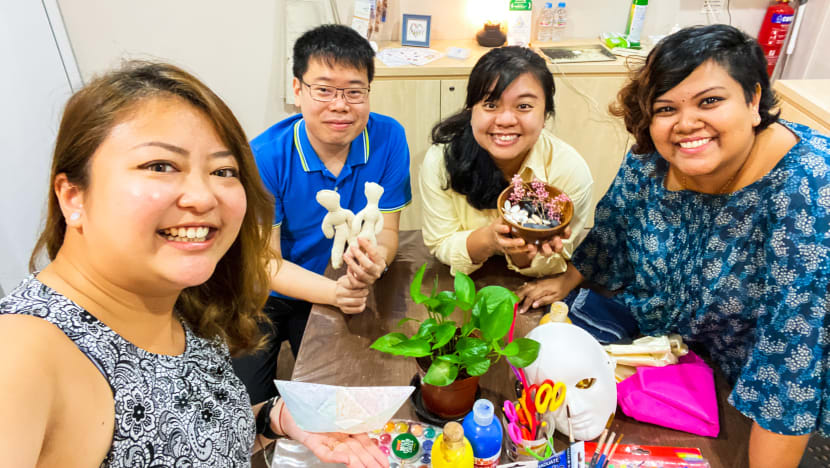
The Solace Art Psychotherapy team. (Photo: Buvenasvari Pragasam)

SINGAPORE: When Deanna (not her real name) first started going for art therapy last year, it was to heal from a bad patch at work and pandemic-related stress. But the sessions also uncovered some hurts she thought she'd recovered from: A bad breakup from nine years ago.

“In those nine years, I’ve been in two other relationships,” she said. “To me and to everyone else around me, I’d moved on already.” Yet, one directive during her session — to draw someone standing in the rain — triggered memories of the fiance who cheated on her. Never mind that it was only a “stickman” that she had drawn. 

“It was a very painful memory... A very dark time in my life. It was interesting to me that I (was) somewhat stuck in that time,” said Deanna, 30, who requested anonymity.

The 18 sessions she went through involved doing picture collages, free doodling, plasticine modelling and other art-related activities. They helped bring back memories from her childhood that made her realise why she did not process her breakup well or handle subsequent relationships properly.

Such incidents are what art therapist Buvenasvari Pragasam, or Buvi, calls traumatic events. Trauma is commonly known as an emotional response to a deeply distressing or disturbing event that affects one’s ability to cope, and a quick Google search throws up examples like being in a war zone or natural disaster.

But few know that distress can result from an embarrassing incident in the past, such as being told off by a parent or a faux pas among friends. Art therapy, said Buvenasvari, can provide a “portal” to unlock trauma that people are often not able to verbalise. And art skills are not needed to reap the full benefits of the experience.

Although still sometimes thought of as art jamming or colouring books, art therapy is, in fact, a form of psychotherapy using the creative arts that has been gaining traction in recent years.

It is a “distinct mental health discipline” that should be provided by a trained professional, said Ronald Lay, leader of LASALLE College of the Arts’ Master of Arts Art Therapy programme, whose training includes 816 hours of evidenced supervised clinical placement.

With more research showing how art therapy can support mental wellbeing, more art therapists are being hired as full-time staff in hospitals and voluntary welfare organisations, where previously they were engaged on a contract or project basis, said Ng Jue Ann, secretary of the Art Therapists’ Association of Singapore (ATAS).

Demand for art therapy has risen since the pandemic, especially during the “circuit breaker” period in 2020, said ATAS president Rachel Yang.

Some clients may have tried the more conventional “talk therapy”, or counselling, but may not feel it has helped them beyond a certain point, she said.

WHAT’S ART GOT TO DO WITH TRAUMA?

Art making is an activity that engages the right brain, explained Buvenasvari, and it will allow the individual to bring out memories that have been bottled up.

Studies have shown that traumatic memories are stored in the right brain, which is more intuitive, emotional and visual. In some cases, the right brain shuts down to block out overwhelming trauma in order to protect the individual “so that one can move on”, she said. 

The left brain, which affects one’s speech and reasoning, shuts down during the traumatic event and prevents the individual from verbally expressing what has happened, she added.

Sometimes, the left brain, which is the logical, verbal side, might “take over”, causing individuals to over-rationalise and “mask their trauma”.  

I don’t ask them what happened. The artwork reveals it.

This was the case for Allan (not his real name) when he first started seeking therapy in late 2019. He realised that he might “naturally leave out certain things (he) did not wish to share”.

But after hearing from a friend who was able to fully express himself “naturally, without realising” in art therapy, Allan decided to try it out. “It didn’t go beyond the third session for me to be convinced that we’re finding out a lot more,” said the 34-year-old, who spoke on condition of anonymity.  

This is why art therapists are wary of individuals without proper qualifications who tout their services as art therapy.

“They think that ‘hey, art making is therapeutic’. It is, but when (trauma) comes out… how are you going to support (the person) without causing further damage?” said Buvenasvari, who runs Solace Art Psychotherapy.

Unqualified providers might “re-traumatise” clients if they probe too deeply or “belittle” them by advising, said Yang. 

“We are not just painting a pretty picture. It’s a lot of psychodynamic work. Clients see this as a space to talk about deep psychological trauma,” said Yang. “If (providers) are not trained, they may ask the wrong questions, they may get them to do things that will do more harm.”

WHAT CAN ARTWORK SHOW?

One of the benefits of art therapy in addressing trauma is not having to talk about the event itself. Clients like Deanna find it “less intimidating” as she doesn’t have to struggle to “find the words” to express how she feels. 

“I don’t ask them what happened. The artwork reveals it,” Buvenasvari said.

It also provides a “safe zone” where the therapist and client can address issues by talking about the artwork and not “directly” to the client. This, she said, lends a degree of separation and can make the client feel more comfortable.

With some simple directions, such as asking her client to freely doodle with a marker, Buvenasvari encourages them to create art intuitively. And from the results, she prompts them to explain what they see or connect with.

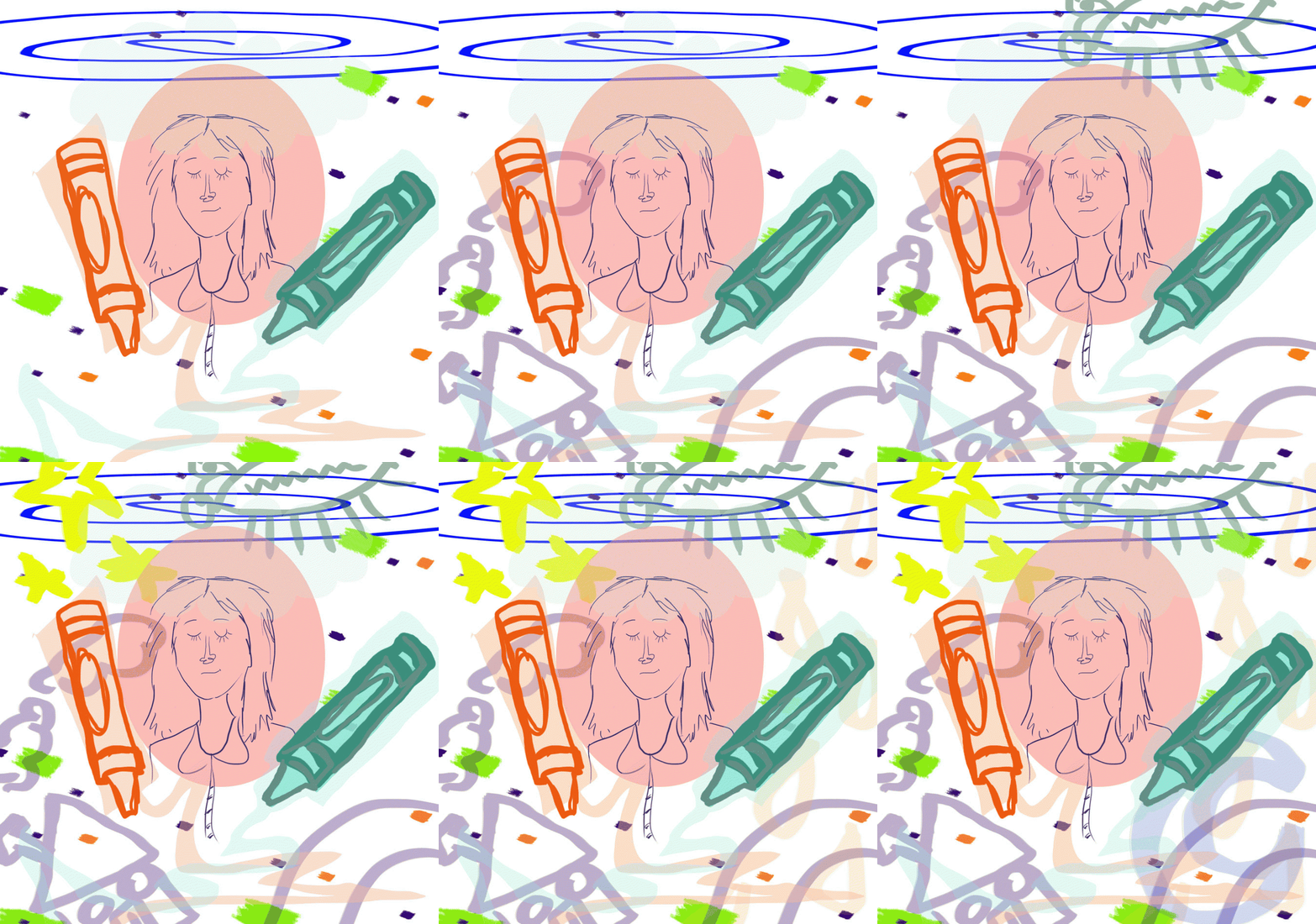
In one case, a client saw an elderly woman in her “squiggle drawing” and this reminded her of her late grandmother. Buvenasvari invited her to enhance the image and as the facial features appeared, the client opened up that she never actually processed her grief. 

She had been living with the guilt of feeling responsible for her grandmother’s death, Buvenasvari said.

In a session using ink and string to draw freely, another client saw dark roads, and was asked to add on to the imagery. She filled in some white spaces and it eventually revealed lips and a meadow within (which was later inked over), which triggered the memory of a domestic quarrel that she felt she could not speak up about. 

Even during the art making process, there are signs Buvenasvari can spot, such as when clients do not ask for help if they spill something. “That would reveal that they don’t have the help-seeking behaviour in real life,” she said. 

In one hand-painting session, Allan’s therapist noticed that he did not attempt to use his whole palm, only his fingertips. Was he uncomfortable with trying new things, his therapist asked. “I was very surprised that she was able to tell and identify these things,” he said. 

Art therapy helped him to understand why he suffered from low self-confidence. “There may have been a certain someone back in the past that may have affected me… as a kid,” said Allan. 

“It took me a while to realise that I may not have moved on, so the way I approached failures was in a very negative manner,” he explained. “I was able to go back and help that kid, (my) 10-year-old self or 15-year-old self and rewire that part of it."

BUILDING UP THE HEALTHY ADULT

Art therapy tries to “build up the healthy adult” by strengthening a person’s identity and addressing the root cause of certain behaviours or tendencies, said Buvenasvari.

“We all have our inner child. If your inner child has wounds, past scars, your inner child remains,” she said. “When you are an adult, sometimes regressing into that inner child is a way to deal with certain things, like throwing a tantrum.”

In Deanna’s case, her “biggest impetus” to sign up for art therapy was people telling her she was “angry all the time”. 

“I didn’t like that image of myself,” she said. “Why does everybody think I am this angry, hot-tempered person?”

There are a lot of things that, as we grow up, we keep sweeping under the rug.

During her art therapy sessions, she was able to revisit memories from both her childhood and the recent past. She realised that the root of her issues was feeling neglected as a child. 

She often had to care for herself, so anger became her defence mechanism when others tried to care for her. And in her relationships, she always felt that she was not good enough and often argued with her partner, she added. 

Beyond having clients express their trauma, Buvenasvari may encourage them to transform their art work, such as by clothing the person they have doodled, or providing a lifeline to, say, a dummy stuck in a glass bottle. 

“Part of them is out on the table, and it’s visible, so we are able to move things around, hold it, and feel it tangibly,” she said. “You are literally able to mould yourself, mould the trauma, transform it."

Sometimes when clients are not ready to address the issue, she would turn to “grounding techniques” such as the drawing of repeated patterns or creation of colour swatches. This helps to slow the mind. 

These are additional tools that therapists can employ that are not part of art therapy per se, and such activities can also be done at home when one feels overwhelmed, she said. 

For Deanna, being able to rip up the watercolour drawing that emerged based on memories of her ex-fiance helped her to “leave this memory behind”. She credits this action for now being able to talk about him without crying. 

And now that she knows anger is her defence mechanism, she is able to notice when “(her) heart is beating too fast or (her) thoughts are racing”. Instead of flying into a rage, “I will try to remove myself from the situation, go for a walk or go to a private space”, she said. “I don’t want to hurt myself or the people around me."

MARK OF SUCCESSFUL HEALING

One of the biggest takeaways for Deanna is that therapy is not just “for people with big traumas and big problems”. It can benefit even those with “very simple” problems like difficulty sleeping or overachieving, which could have its roots in childhood trauma. 

“There are a lot of things that, as we grow up, we keep sweeping under the rug,” she said. 

And while some may fear revisiting skeletons in the closet or reopening a chapter that has supposedly been closed, Deanna thinks “it must be done” or “it will keep popping up in other ways in your life”.   

“When things happen to you, it's painful, traumatic,” said Buvenasvari. “Either you suppress it or you think you have healed from it, so you don't want to revisit it. But it’s there. Why is it so difficult for you to look at it again? It means that it’s still affecting you in one way or another.” 

Buvenasvari is happiest when she sees clients being able to verbalise their issues without feeling overwhelmed. That, to her, is a mark of “successful healing”. 

“When you really process your trauma, it is no longer a skeleton in the closet. It’s just an old T-shirt.”

To find out more about art therapy, visit The Red Pencil (Singapore): https://redpencil.org/singapore/ 

Where to get help:

Samaritans of Singapore Hotline: 1767 221 4444

Institute of Mental Health’s Helpline: 6389 2222

Singapore Association of Mental Health Helpline: 1800 283 7019

You can also find a list of international helplines here. If someone you know is at immediate risk, call 24-hour emergency medical services.

Friday, July 27, 2018

Interview with my former professor Tally Tripp on art therapy

Art Therapy Is More Than Just Making Nice Pictures

One art therapist explains how making art can save lives.

Priscilla Frank
Anyone who has ever put pen to paper, crayon to coloring book, or hand to wet clay knows the healing powers embedded in such creative endeavors. More than just a pastime, art can be an escape, a stimulus, a war cry or a tranquil reprieve.

Art therapy, defined as “a form of psychotherapy that uses art media as its primary mode of communication,” revolves around this principal of art’s immense power. Open to children and adults of any background and experience, the still-evolving field explores modes of expression, understanding and healing that occur when paint touches canvas. While too many schools today run under the assumption that art is extraneous, a diversion from traditional academic subjects, art therapists know better. They know that art has the potential to change lives, and, even to save them.

Tally Tripp is the art therapy clinic director of George Washington University, specializing in individuals who have experienced trauma. Entering the field in its nascent phase, in the 1970s, Tripp was elemental in shaping the field as we know it today.

Continuing The Huffington Post’s coverage of the often misunderstood field that is art therapy, and the pioneers who continue to sculpt it, we reached out to Tripp to discuss the details of her career’s past and present.


How did you become interested in art therapy? How did you learn about the field?


When I first learned about art therapy it was definitely a field in its infancy. Personally, I have always loved art making and combined that with an interest in working with people. In high school I spent summers in New York working for the Children’s Aid Society with disadvantaged children in a camp program. It was there, as a counselor in the arts and crafts program, I came across one of the original art therapy journals: the Bulletin of Art Therapy (edited by Elinor Ulman and produced between 1961-1970).

For many years, that journal was the only art therapy publication available. At the same time, in 1971, Elinor Ulman and her colleague, psychologist Bernard Levy started an art therapy program at the George Washington University. Pretty quickly my goal became to study art therapy in the master’s program at GW, which I did between 1978 and 1981. Now, full circle, I am a full time professor in the art therapy program at GW and the director of the GW Art Therapy Clinic.

How did art therapy look when you first immersed yourself in it?

In the late 1970s, art therapy was still an emerging profession. It was definitely an exciting time for the field as we students were taught by some of the early pioneers: Elinor Ulman, Edith Kramer and Hanna Kwiatkowska — innovative thinkers developing clinical approaches that were based largely on intuition coupled with psychoanalytic thinking that was popular at the time. Also in those days there were few texts or research studies on art therapy to guide us, so we learned primarily by our experiences and our clinical work. As art therapy was a relatively unknown profession, we all put time and effort into spreading the word and educating others about its value.

The field is more established now, and more often than not, people have heard of art therapy and have some understanding of how it works. Art therapists now have licenses in some states as well as levels of professional credentialing and board certification. Beyond that, we have a lot of art therapy literature at our fingertips including research studies supporting the efficacy of art therapy and describing how it is utilized across many settings and populations. Art therapists can now be found in various settings — from medical and psychiatric hospitals, to schools, geriatric facilities, community and studio settings, and in private practice.
What are your areas of interest in the field?

I have maintained a private practice in art therapy for over 30 years. My specialization is working with individuals who have experienced trauma. I find these clients are excellent candidates for art therapy precisely because the art can provide a means for expressing the inexpressible feelings that are often shut down or pushed away from consciousness in response to traumatic events. It has been exciting in the last 25 years to see that neuroscience research has validated the kind of work we do. Through brain imagery, we now know that the cognitive and executive functioning of the brain is for the most part “off line” when people are recalling their traumas, rendering them essentially “speechless.” This helps explain why traditional verbal therapy is often not enough when working with trauma, and why art (imagery) and other experiential therapies are so effective.

I reached out to you in part because of Suicide Awareness Month. In your private practice do you work with many patients grappling with suicidal thoughts? What are some of the methods you practice in such circumstances?

Any therapist in private practice will have to deal with patients who are struggling with suicidal thoughts from time to time. Negative beliefs and hopelessness can render the individual helpless to combat the urge for self-harm. To work with suicidal thoughts, a clinician must first assess how developed the plan is, and, if the patient is truly in imminent danger of self-harm, hospitalization may be required. But hospitalization has its limits and is only one step.

Are most of the patients you encounter already involved in art? Are they ever skeptical?

It is true that most people think of going to an art therapist because they enjoy making art and are already involved in it somehow. But that is not the only kind of person who will benefit from art therapy.

For example, one man I worked with was also being seen in marriage therapy and was referred to me because it was determined that he needed to access more emotional depth. This man had no apparent interest in art, but agreed to see me as an experiment because art therapy had been recommended. I invited him to work on a picture of simply lines and shapes and just “see what happens.” His first picture, a simple downward sloping line was created in a matter of seconds. But when we held the “picture” up and explored it from a distance, he became struck by the downward motion and then exclaimed: “This is exactly what I have been trying to describe. It looks like my mother’s lap. Empty. She was never able to really hold me!” The image and description of not being held as a child became a fundamental theme in our work together. And within a few months, this patient enrolled in a painting class and began a new appreciation for art.


Brigitte Wodicka via Getty Images

Can you explain what you hope to achieve with a suicidal patient through art therapy? What changes are you looking to make?
Often the artwork will convey a suicidal feeling of hopelessness or despair long before words are consciously available. The image can provide a means for discussing feelings that are either unclear or difficult to verbalize. Art works tend to be self-referential so we work actively with the images and themes that are produced.

For example, an image of a desolate landscape might signal an empty feeling and suicidal state in the artist. While I do not interpret the image, the patient and I will work together to explore the metaphor and any personal meaning or feelings that are attached. Because the picture is something we can look at together, it gives both artist and therapist an opportunity to “do” something with it. Art therapy can empower the individual to find a solution or create a “preferable ending” in the art. It is interesting to note that creating artwork that challenges the initial feelings of hopelessness will actually affect the neural firing in the brain. The more practice a person has exploring “preferable endings” for example, the more this will result in the brain finding alternatives to self-destructive behavior. So making art can be a good practice for seeking solutions and reducing negative thoughts.

Is there a certain type of patient you think is more suited to art therapy as opposed to other therapy methods?

Anyone who is willing to explore feelings through the process of making art can benefit from art therapy. Some people will naturally be drawn to this kind of therapy — children in particular where their natural language is through art and play.

Adolescents are also good candidates for art therapy because they may be resistant to traditional talk therapies and usually will enjoy working with art materials. I work with adults, however, and maintain that they are still children inside, as it is often an adult embodying that child state coming in to my office. The art helps bypass the defense and intellectualization inherent in verbal language. When a new (adult) patient is referred to me, I often start by asking, “Why do you think art therapy will help?” Right there, I am getting an alliance with the patient by suggesting that I believe that the experiential and creative nature of making art, in the company of an attuned art therapist, will make a difference.

What makes art therapy so powerful?

Art therapy is more than just making nice pictures. In fact, art therapy is more often a process of making ugly or messy pictures that depict a feeling state, not a final product that is all neat and tied together. Art therapy is about that creative process where the client, in the company of an art therapist, is working and re working problems via a range of fluid and variable art materials.

In private practice, I find the spontaneously created art pieces are the most meaningful and often help a person find resolution for specific traumatic experiences. The benefit occurs when the art made facilitates a sense of mastery over the problem. For example, a patient who has experienced years of abuse or neglect in childhood may be able to finally express feelings that had been avoided or pushed out of conscious awareness because they were overwhelming at the time. The images often speak more loudly than words. With the encouragement of the art therapist, difficult feelings can be expressed through making art.

The process varies widely so there is no one way to describe what happens in a session. When a person first faces a blank piece of paper, there might be some resistance or hesitancy to explore feelings so the resultant images may appear tight and controlled as in a line drawing or pencil sketch. But after some trust is established in the therapeutic relationship, the art process can move towards more expressive activity, which would suggest the patient is accessing stronger emotion. Often the patient will begin experimenting with more evocative materials at that point, for example using paint or clay to express feelings like anger, shame or fear. The art therapist is knowledgeable about psychological problems and the use of various art media; the process is flexible and individually focused to support the patient to find materials and techniques that connect with the issues at hand. And as a patient becomes more open to the process and discovers more creative resources within, the art product will also change. In art therapy, there is always that creative edge that keeps the process dynamic and contributes to the process of healing.


Need help? In the U.S., call 1-800-273-8255 for the National Suicide Prevention Lifeline.