News | Aug. 15, 2024
Walter Reed Offers Partial Hospitalization Program for Mental Health Care
By Bernard Little

Walter Reed National Military Medical Center, BETHESDA, Md –
Walter Reed offers the Partial Hospitalization Program (PHP), providing support and skills to assist people in managing their behavioral health challenges while living at home.
The program offers a structured treatment setting with a scheduled list of activities during the day, and participants returning to their homes at night, explained Navy Lt. (Dr.) Meghan Quinn, a psychiatrist, PHP chief and assistant chief of Navy Graduate Medical Education at Walter Reed.
PHP patients have no acute safety risk for themselves or others, Quinn explained. They can function at a higher level when they stay in contact with their loved ones (not housed separately or isolated) and patients like it. They can see their partners, kids, pets and others on a daily basis, which is beneficial to their recovery and treatment, she added.
The program began at Walter Reed Army Medical Center (WRAMC) and transferred to Bethesda, now Walter Reed National Military Medical Center, following (Base Realignment and Closure) BRAC and WRAMC’s closure in 2011.
During the COVID-19 pandemic, the program experienced a reduction in hours, but last year, it resumed its hours prior to the pandemic. PHP is now celebrating its one-year anniversary of comprehensive trauma and general mental health treatment provided to active-duty service members, said Quinn. She added that nearly 300 patients have received this care during the last year.
The PHP at Walter Reed is a full-day program, with patients coming here as their place of duty with command approval. There is great benefit in staying in military spaces, Quinn explained. Regular communication with the patient’s command and outpatient treatment team on their progress can include fitness for duty recommendations with an eye on military standards and goals of both patients and their command.
Quinn explained the structured program is four or five weeks “The content builds so you can start at any point and not wait,” she said. There is generally a technician-led group first thing in the morning, and one closed group each day where patients and staff can address heavier topics, such as coping with suicidal thoughts.
There is a final optional group most days that patients can “wind down depending on what [kind of] day it’s been,” Quinn said.
“[The PHP] has the capacity to treat up to 40 patients at one time,” said Quinn. “We try to keep the ratio manageable so groups don’t get too big, and everyone can participate.” She went on to describe how patients are divided into two separate treatment programs upon intake. The Comprehensive Recovery Program (CRP) focuses more on general mental health topics, and the Trauma Recovery Program (TRP) helps patients process traumas that have occurred at any point in their lives that are impacting their current functioning now. These treatment programs may be split into smaller cohorts at times based on type of trauma, or other factors.
In addition to Quinn, core staff for the PHP includes 10 primary therapists (four psychologists, six social workers, an art therapist, two psychiatrists, a nurse practitioner. “The staff here are fantastic. They have a lot of experience working with military patients and their specific concerns.” She added most are former military or spouses of service members. Rotating trainees include one psychiatry resident, and at times, medical students, 66C (psychiatric nursing) students, and Interservice Physician Assistant Program (IPAP) students.
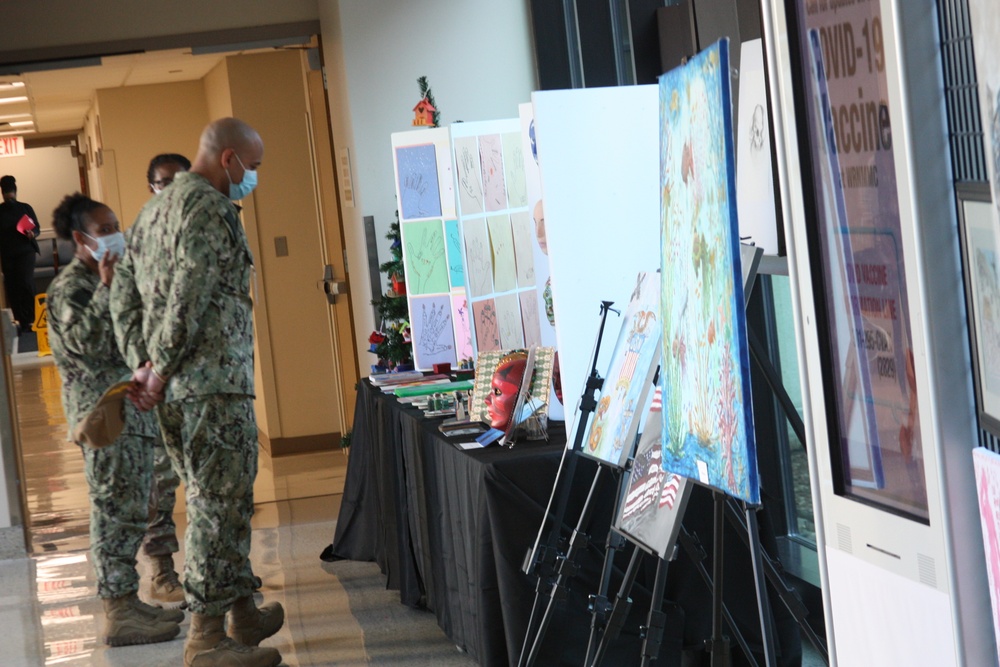
All patients receive formal art therapy once a week and participate in trips outside of Bldg. 85T at Walter Reed, the current home of the PHP.
“We have had a few recreational activities. We’ve been to the zoo, have gone rock climbing in Rockville, Maryland, to Great Falls, Virginia and to Brookside Gardens, Maryland,” Quinn said.
There is also horticulture therapy, and Quinn added that a therapist also arranges for patients to receive regular visits from Walter Reed’s facility dogs.
“All of our patients see their prescriber weekly for medication management, in addition to having two individual therapy sessions most weeks,” Quinn added. “We meet as a clinic team once a week to discuss the progress and clinical condition of every patient in the PHP, so we are able to truly give a comprehensive overview of their status and treatment.
Quinn explained that there has been a stigma about people seeking help for mental health care, particularly service members, fearing the impact it may have on their careers. “People in the military are often hesitant to try [therapy] but here [to provide the] best mental health [care].”
According to a 2006 study in Military Medicine, 97 percent of service members who seek mental health treatment do not experience any negative career impact. In addition, seeking mental or behavioral services will not affect a service member’s security clearance (https://tricare.mil/PatientResources/MediaCenter/TRICARE-Videos/Will-Mental-Health-Services-Affect-My-Security-Clearance#:~:text=The%20short%20answer%20is%3A%20No.)
Quinn added that the PHP includes a number of adjunctive therapies, including Transcranial Magnetic Stimulation (TMS), which she collaborates with Dr. Vanessa Torres-Llenza to tailor these therapies for patients. TMS uses magnetic pulses directed toward the brain to treat severe depression or anxiety, Quinn shared.
Another adjunctive therapy used in the PHP is battlefield acupuncture, in which five tiny, sterile needles are placed on a patient’s ear, which simply fall off after a short time. “It was originally [used] for pain and insomnia and is a great adjunctive therapy where depression decreases,” Quinn explained.
The program has also experienced positive outcomes with Alpha Stimulation, which helps with chronic pain and insomnia, and assists patients with relaxation, Quinn explained.
Quinn added that the PHP has a memorandum of understanding (MOU) with Building 62 at Walter Reed to house patients who come from long distances, since this is the only PHP of its kind in the National Capital Region (NCR). “We meet that need, and [patients can] stay when commands [elsewhere] don’t have access [to a PHP program].”
“We are always looking at ways to adapt the program to meet the needs of our current patients and monitor trends in referrals,” said Quinn. She explained that this has led to incorporating trauma treatment into the general mental health program, including adding eye movement desensitization and reprocessing for post-traumatic stress.
“[We would like to] have information on the program spread,” Quinn said. “We have resources to work and connect with them. [We love how] patients talk to each other and get referrals. Somebody in your company was here and now word [about this PHP] is making its way around.”
She said that nearly every rank, including enlisted personnel up to E-9 and officers up to O-6, have taken advantage of the PHP. “This is the only adult PHP in the NCR without going out of the network,” she stated.
For general questions about the program, contact the PHP front desk at 301-400-2110.
If you are having a mental health emergency, please call 911, 988 (988 Suicide and Crisis Lifeline), or go to your closest emergency room.