Showing posts with label autism. Show all posts

Thursday, November 30, 2023

How Art Therapy Can Help Autistic Adults

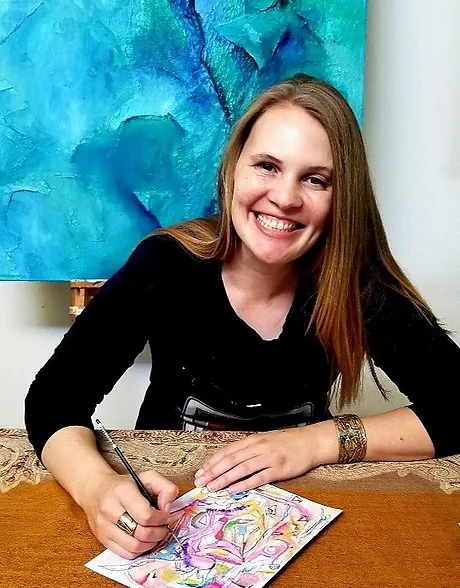
 Every now and then, I have some wonderful guest writers who contribute posts to this blog.  I am happy to share such a post from a fellow art therapist, Jackie Schuld, ATR-BC, REAT, LPC.  

Jackie is an autistic and ADHD writer, artist, and therapist. Her upcoming book, "Life as a Late-identified Autistic" will be published in January 2024. She runs an art therapy private practice that specializes in late-identified autism and ADHD. You can learn more about her work at https://www.jackieschuld.com

I am thankful to present her expertise and insights on how art therapy can be helpful for autistic adults in particular.  Please read on...


How Art Therapy Can Help Autistic Adults

We autistics have incredibly complex minds. 

 We can have a hundred thoughts at once.

We can have a conversation with someone, and have a background program running that is assessing the conversation at the same time. 

 We can think deeply on a subject, connecting dozens of tangential thoughts. It’s a beautiful web of thoughts that can lead to creativity, innovation, passions, and joy.

But our complex minds can also leave us exhausted. Sometimes our minds go into overdrive as we try to process all that we took in from the day and the millions of connecting thoughts. Our emotions can also get easily sucked into the matter, leading to emotional lows.

Before I knew I was autistic, I described myself as having overwhelming emotions and thoughts.

I thought therapy would help me reduce my emotions and thoughts.

It didn’t.

I thought that meant I failed at therapy.

In reality, the therapy I received wasn’t tailored to my neurodivergent mind.

My therapists didn’t know I was autistic, and neither did I.

But now I know, and I’m doing things differently.

Instead of trying to “change” my mind, I’m learning how to work with it.

I accept that my mind will always produce a lot of emotions and thoughts. I now provide more space and mediums for my mind to process all of that at a pace that doesn’t feel overwhelming for me. I also do it in ways that feel good.

That’s what I love about art therapy. It provides me with the space to do just that.

For example, if I’m feeling frustrated about a topic, I don’t try to “talk” my way through it. That often makes it worse. Instead, I make art about it.

Art helps us to see things from different perspectives. It also lets us express our emotions fully.

Many times, our emotions need more attention before they can extinguish.

I’m now an art therapist who specializes in late-identified autism. I work with neurodivergent folx who are new to their autistic/ADHD identities.

Learning you’re autistic is freeing, but it’s also a lot to process. Art therapy can help us to do that.

Sometimes I invite clients to make collages about their autistic identities. It brings many subconscious feelings and thoughts to the surface.

Other times I invite clients to create bubble maps about their autistic characteristics. It provides the clarity and organization that our minds crave. We can also then review their maps together to identify characteristics they may not have considered.

Sometimes I invite clients to make abstract paintings of how they currently feel. I call them emotional portraits. Learning you’re autistic is a weird mix of relief, grief, anger, joy, and more. It can be a lot for us to describe. Art can help us to get all of that out.

There’s an endless amount of ways that art therapy can help autistics to feel better. There’s no “list of art therapy activities to go through,” at least not in my practice. Instead, everything is tailored to where the person is at in their journey, their interests, who they are, their comfort with different art materials, and more.

That’s the beauty of working with an art therapist, versus just doing art on one’s own. An art therapist can guide you at a pace and in a way that is suited to who you are and what you’re needing.

It won’t change who you are, but it will certainly make you feel far better about who you are.


Thursday, March 12, 2020

Saturday, December 27, 2014

Saori Weaving as an intervention for persons with disabilities

Brandy Godsil, an artist and weaver, brought to my attention a project on which she is working, using Saori Weaving as a form of aiding autism, as well as other disabilities, with textile art.   She started working with her adult autistic brother to help him using this form of weaving.  Loop of the Loom, the studio where she works, is organizing an event to be funded via Kickstarter.  The proceeds from the event will go towards creating a nonprofit weaving organization in the USA, since this weaving method began in Japan and is already being used to help people with disabilities there.  Check out their Kickstarter campaign to consider contributing to help make this event happen and help people through a textile form of art therapy. The campaign will end on January 7th, so consider your pledge soon!


Monday, September 29, 2014

Autistic girl's paintings attract attention

Five-year-old Iris Grace is raising awareness of autism through her extraordinary paintings

by Roisin O'Connor

A five-year-old girl with autism has garnered praise across Europe, Asia and America for her astonishing artwork.  Iris Grace, who lives with her family in Leicestershire, began painting last year, and has already been praised by buyers, collectors and galleries for her work's intense colour, immediacy, and open composition.  Her paintings are sold to private art collectors in the UK and around the world for thousands of pounds each, with all profits going towards art materials and therapy.  Arabella Carter-Johnson, Iris’s mother, said that Iris loves being outside and that she can see “so much of nature in her paintings."

Iris with her cat Thula 

“She will watch water, trees, wind, leaves, flowers, birds, clouds… she is so interested in movement and how it changes things.” She added that Iris is “very musical” and has been since she was a baby.  “It was the one thing that always calmed her,” she said. “Iris is particularly into classical music at the moment and knows all of the orchestra instruments. She adores the violin.” Iris’s cat Thula is another source of inspiration, and features regularly in her work, such as her painting ‘Raining Cats’.

'Raining Cats' by Iris Grace  

“There have been a lot of references to Monet because of the Impressionistic style. We have had many artists, dealers and galleries contact us who are very complimentary about her work which is lovely,” Iris's mother said. “For us though the joy that Iris gets from creating her pieces is the highlight, how it changes her mood, how happy it makes her.” Due to a lack of awareness, people with autism and their friends, family and carers often struggle to explain just how strong an impact it can have on a person’s life. Iris's mother said that her daughter had great success with play therapy, music therapy, and now a new form of speech therapy which uses video, created by a company called Gemiini “By following Iris’s interests, her ‘spark’, I have been able to engage her in many things,’ Iris's mother said.  "We have started our own activity club that supports children with autism, and run that every Saturday morning."

Iris at work 
Iris at work  

Celebrities such as Ashton Kutcher have shared Iris’s work on social media, while three-time BAFTA award winner Olivia Colman showed her support by reading a poem for a video about Iris. Several high-profile figures are active in raising awareness of autism, including actor Daniel Radcliffe, who is a patron for the Autism Research Trust.  “I am sure his [Ashton Kutcher’s] post has had a huge impact, said Iris's mother. "Our society now is so interested in what celebrities say or do that any comments from them will undoubtedly raise awareness."

You can learn more about Iris's work on her website


Tuesday, October 01, 2013

Candid Conversation with Voice Actors Jess Harnell, Jim Cummings, and Rob Paulsen on Autism

Though you may not recognize these names up front, you're highly likely to know the characters they have voiced.  Listen to this podcast that they recorded of a conversation with these men on the topic of autism.

Conversation with Rob Paulsen, Jim Cummings, and Jess Harnell about Autism

Jennifer Jordan
October 1, 2013      
   
Conversation with Rob Paulsen, Jim Cummings, and Jess Harnell about Autism

  Listen to the podcast here:


Winnie the Pooh and Yakko and Wakko Warner Discuss Autism at GraniteCon 2013

From GraniteCon 2013, we have an uncommon and memorable experience with some incredibly iconic people to share. Our friend, Gary Sohmers (CEO of IMAGE and pop culture expert), sits down with Rob Paulsen (“The Adventures of Jimmy Neutron: Boy Genius,” “Animaniacs,” “Mickey Mouse Clubhouse”), Jim Cummings (“Darkwing Duck,” “The New Adventures of Winnie the Pooh,” “Chip ‘n’ Dale Rescue Rangers”), and Jess Harnell (“Drawn Together,” “Animaniacs,” “Wreck-It Ralph”). What starts as a candid conversation about Thomas and Jenni’s son, Lex, morphs into a round-table discussion from Rob, Jim, Jess, and Gary on personal experiences they’ve had within the autism community. What ensues is a touching, sincerely personal talk about the opportunities and changes that are developing for individuals and families living with autism. A big “thank you” to these fantastic men for taking the time to talk with us, Mary Dumas and Gary Sohmers for moderating, and to GraniteCon and Jeff Zannini for facilitating.

Show Notes:
The first couple minutes of the podcast were never meant to be published. The conversation, however, was so organic that we decided it needed to be included.