We have likely heard of "fight" or "flight" as a typical response to being in danger or a stressful situation, and in recent years, many have included the "freeze" response. However, there is a fourth term that has been included in the stress response, which is usually referred to as "fawn." However, I like the term "feign" that Dr. Cathy Malchiodi puts forth as another way people manage their way through precarious situations. Read her article further and think about what you might incorporate into your terminology and treatment approach.
TRAUMA
Understanding Fight, Flight, Freeze, and the Feign Response
“Fawn” is a disempowering term when it comes to trauma.
Posted June 13, 2021 | Reviewed by Gary Drevitch
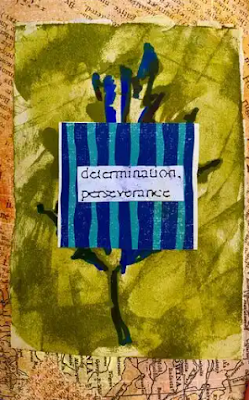
© 2020 Courtesy of Cathy Malchiodi, PhD
"Self-Preservation," collage from the visual journals of Cathy Malchiodi, PhD
Responses to danger are physiological reactions traditionally known as fight, flight and freeze (sometimes called collapse) (Cannon, 1932). Trauma specialists define these reactions as neurobiological responses to threat. One widely accepted concept is that the thinking brain (neo-cortex) is often automatically dominated by the mid-brain (in particular, the amygdala) during moments of fear. This means that the mid-brain goes on high alert and signals the sympathetic nervous system to release chemicals to prepare the body for fight or flight. If it is not possible to escape or fight, the limbic system then engages the parasympathetic nervous system to initiate a freeze or collapse response in the body, resulting in immobilization, restricted breathing, and decreased metabolism. In humans, freeze reactions may include psychological dissociation. Threat and danger signals may include real threats such as possible assault or physical harm, but they can also be as simple as humming fluorescent lights, the whir of a fan, or the popping sound coming from a car engine, causing individuals to automatically feel unsafe.
The Fawn Response
In 2000 (Taylor et al), “tend-and-befriend” was proposed as a stress response in females. Researchers proposed that “tending” related to nurturing designed to protect the self and offspring and befriending involved the establishment and maintenance of social networks. The assumption was that females have a greater role as caregivers and use tend-and-befriend to create safety and reduce stress. For various reasons, the researchers found that the flight response to stress may be inhibited in females and that other responses related to caregiving and social survival are used for under conditions of stress.
A few years later, a fourth possible response emerged in trauma discussions: the fawn response. This terminology is often credited to Walker (2003) who attributed it to “codependent defense” and followed a tradition in English-speaking trauma terminology of using a word starting with the letter “f.” Walker described fawn types as those seeking safety by merging their needs, wishes, and demands with others. These individuals respond to distress by forfeiting rights and boundaries, becoming compliant and helpful, somewhat like the children described by Alice Miller’s The Drama of the Gifted Child (1979). According to Walker this response may become part of other trauma reactions, combining with fight, flight, or freeze depending on what is encountered.
Fawn ubiquitously appears without question in just about every current meme, chart, or infographic defining core trauma responses. But it is now time to take a step back and revisit this descriptor and the connotations that accompany it. It certainly is no longer defined as a "defensive" strategy as originally described by Walker. In particular, the use of this term subjectively feels directed at women, perhaps because of its original definition as a female “tend-and-befriend” response more than 20 years ago. To fawn is also described as having a lack of identity and boundaries and a general sense of being so overwhelmed one cannot act in one’s behalf. Used to describe “people-pleasing” or “passivity” when confronted by possible assault, terror, or atrocity, the negative connotations of “fawning” are depreciative, pejorative, shame-based, and perhaps, culturally or gender-biased.
A Reframe of Fawn to Feign
In working with individuals with traumatic stress for several decades, I have listened to many stories explaining impressive adaptive coping skills when faced with threat or danger. These often include complex strategies like negotiation and improvisation to consciously protect themselves from harm. Children and adults have reported that they “faked” responses to those who intended assault to stay safe in the moment. For example, one survivor of a hostage situation clearly conveyed to me the value of consciously fooling her kidnapper. She knew she could not “fight or flee,” and instead developed a relationship with her captor over time, using very convincing appeasement as a strategy. As it turned out, it was successful in preventing physical assault until she could actually escape her imprisonment (Malchiodi, 2020).
In decades of work with survivors of assault and terror, I have used what I believe is a less shame-based term—to feign, a purposeful action taken in order to escape danger and defuse threat. By definition, feign implies a more artful invention than just mere pretending. As a trauma response, an individual may simulate befriending, deferring, negotiating, and/or bargaining in service of self-preservation or saving another. Feigning may also be part of the other three trauma responses (fight, flight, freeze). For example, some individuals report consciously pretending to be immobile, as animals automatically do to distract predators. In these cases, it is not just the body’s dissociative response; for these individuals, it is a deliberate and decisive action when in danger.
Feigning is an assertive action that supports survival in the moment. However, one outcome of repeated feign responses is that these actions may become a natural part of how we interact with others and the environment when stressed. So yes, when people-pleasing, bargaining, deferring, or other befriending behaviors in service of survival are repeated over time they may become a dominant and problematic narrative. Eventually one may come to value others over self, find it difficult to describe feelings or communicate, fear abandonment, or sense an exaggerated responsibility for other individuals. It then becomes important to recognize how these adaptive responses helped in the moment for survival, but may no longer be helping in the long term, impacting mental health and quality of life. This recognition is particularly important in eliminating the shame that many survivors experience, blaming themselves for not fighting or fleeing an assaultive, abusive, or terrorizing situation.
Broadening the Discussion
In trauma-informed practice, I believe there is a more empowering way to frame these responses that may not necessarily be solely the domain of co-dependency or instinctual responses to please others. Reframing fawn as feign is just one more way of broadening this discussion and refining our language and definitions
“To fawn” continues normalized as a valid trauma response in literature and social media. I am simply advocating for a lane change to a different descriptor that acknowledges the action-oriented, self-preservation-based capacity of individuals to survive. Using the word “feign” will not magically erase the shame or guilt one may feel when forced to pretend, ingratiate, or bargain with a perpetrator, even when it is to save one’s own life or the life of another. But it does respect that the individual was able to defuse threat through personal adaptive survival skills and acknowledges the context of danger that existed in the moment. As trauma specialists know, healing comes not only from acknowledging what happened to us, but also that what we did what was right in the moment to survive and ultimately thrive.
References
Cannon, Walter (1932). Wisdom of the body. New York: W.W. Norton & Company.
Malchiodi, C. A. (2020). Trauma and expressive arts therapy: Brain, body, and imagination in the healing process. New York: Guilford Publications.
Miller, A. (1979). The drama of the gifted child. New York: Basic Books.
Taylor, S. E., Klein, L. C., Lewis, B. P., Gruenewald, T. L., Gurung, R. A. R., & Updegraff, J. A. (2000). Biobehavioral responses to stress in females: Tend-and-befriend, not fight-or-flight. Psychological Review, 107(3), 411–429. https://doi.org/10.1037/0033-295X.107.3.411
Walker, (2003). The 4Fs: A trauma typology in complex PTSD. Retrieved at http://www.pete-walker.com/fourFs_TraumaTypologyComplexPTSD.htm.
Cathy Malchiodi, Ph.D., is a psychologist, expressive arts therapist, trauma specialist, and author of 20 books, including Trauma and Expressive Arts Therapy: Brain, Body, and Imagination in the Healing Process.
Online:
Cathy Malchiodi, PhD, Facebook, LinkedIn, Twitter


