Monday, April 02, 2012

World Autism Awareness Day


World Autism Awareness Day


The fifth annual World Autism Awareness Day is April 2, 2012. Every year, autism organizations around the world celebrate the day with unique fundraising and awareness-raising events. How will you celebrate? To share your events, please "Like" the World Autism Awareness Day page on Facebook and submit your events by posting the information on the wall.

Thank you for celebrating the wonderful people in our lives affected by autism on April 2 and throughout April which was Autism Awareness Month. Learn more about some of the events from April 2, 2012 here!


There are a few songs that have been written regarding autism, and would like to share a couple here:

"Solitary Shell" by Dream Theater (from Six Degrees of Inner Turbulence, 2002)


 He learned to walk and talk on time
But never cared much to be held
and steadily he would decline
Into his solitary shell

Read all the Lyrics here 
 
 "Puzzle Box" by Red Lamb (from Red Lamb, 2011)


 Every child’s mind is…
Like a puzzle box
But what of the mind that stays…
That stays forever locked?
Early intervention’s
The key to it all
Now we lift them up
HE won’t let them fall
 
Read all the Lyrics here
 

Here is an interview with Dan and Candi Spitz about their autistic twin sons and 
using Red Lamb's song "Puzzle Box" to increase Autism awareness:


Saturday, March 24, 2012

16-year-old Girl with Asperger's Focuses on Painting to Express Herself

This is a great story that caught my attention, especially since Amanda is from my home state of Oklahoma, and if her art is selected, it will be exhibited in my current backyard at the MLK Library in DC. :)

Amanda LaMunyon: 

Teenage Artist With Autism Paints Brilliant Nature Scenes


Amanda LaMunyon, a talented 16-year-old artist, has Asperger's Syndrome. Instead of being a setback, however, this allows her to concentrate on her painting. Two years ago, Amanda was a finalist in CVS's "All Kids Can Create" contest, which puts a spotlight on creative kids around the country. The young, Oklahoma-based artist writes on the "CVS Caremark All Kids Can" website, "When I put a paintbrush in my hands for the first time, I instantly felt my life change. I could finally focus without getting distracted and my paintings helped me convey everything I had difficulty expressing,"

At only 12 years old, Amanda addressed the United Nations during World Autism Awareness Day. She delivered a poem, "A Little Secret," which she wrote herself. (She speaks around the three minute mark in the video below.) Looking very self composed despite her young age, the precocious artist reveals, "She is very well meaning, but frequently misunderstood." This can be a common complaint among those living and dealing with people who are autistic; at times, it seems they are living in their own world. But this doesn't get Amanda down; instead, it motivates her to create bridges between people. She writes on her website, "I hope to continue to share my art and my story of overcoming challenges."

We interviewed Amanda about her work, and her responses are below.

HuffPost Arts: How did you first develop an interest in art?
AL: I first developed an interest in art and painting when I was about seven years old. I couldn't stay focused, so my parents thought it was a good idea to have an outlet. They looked up art lessons, and I took my first lesson with my teacher, and after my first lesson she said, "I think this girl can paint;" I've been painting ever since.

HuffPost Arts: Have you kept in touch with this teacher?
Yes, she's a very dear friend of the family. We just love her.

HuffPost Arts: Are there any artists who have inspired you?
I like Monet, Van Gogh, the French Impressionists. I definitely consider myself an Impressionist artist so I enjoy that type of work more.

HuffPost Arts: Do you prefer to do landscapes?
It varies. I like doing anything with nature, whether it's landscapes or animals.

HuffPost Arts: What kind of museums do you like in Oklahoma?
We don't have that many art museums here, but I've been the OKC Museum and the Tulsa one.

HuffPost Arts: Were you ever able to see Impressionist work up close?
I was able to see Monets, yes. Whenever I know there's a piece of Impressionist work [I tell my parents], "We're going to this museum!"

HuffPost Arts: Are either of your parents artistic?
Not much. I believe I was born with the ability; I just had to acquire it.

HuffPost Arts: What do you want to do in the next few years?
Painting is my life now. I want to get a degree in graphic art and painting [and] I want to do more work with charities.

See a slideshow of Amanda's work below, and let us know if you've ever found solace in art in the comments section.

If you'd like to participate in "All Kids Can," please submit your or your child's artwork before April 8, 2012 here, and it will be featured in an online gallery. In addition, the artwork submitted could be chosen for display in the “What Inspires Me” exhibition this August in Washington, D.C. at the Dr. Martin Luther King, Jr. Memorial Library. 

Painting to Make a Difference


"There's always that one person that tells you, 'You're not good enough.' But you are. Keep on doing what you love."
This powerful advice comes from Amanda LaMunyon, a sixteen-year-old from Oklahoma who is hoping to change the way people perceive disabilities through her original artwork.

When Amanda was in elementary school, she had trouble concentrating and couldn't sit still in class.  She had difficulty relating to her peers and struggled to stay focused on her daily activities.  "I knew the rules in school but I just couldn't apply them, and I could never adapt social skills when I tried to communicate with my classmates."

Despite her struggles in school, there was one thing that helped Amanda relax and helped her express all the emotions that she couldn't convey to her teachers, friends and family.  "When I put a paintbrush in my hands for the first time, I instantly felt my life change.  I could finally focus without getting distracted and my paintings helped me convey everything I had difficulty expressing."

When Amanda was eight years old, she was diagnosed with Asperger syndrome, a condition that helped explain the difficulties she had experienced in school.  After learning of her diagnosis, Amanda's painting hobby turned into an outlet that connected her with the people that had misunderstood her throughout her childhood.

"Learning I had Asperger's helped me come to terms with what I was doing, and made me all the more passionate to exercise my talents with painting.  I always wanted my artwork to be enjoyed, but hearing about how I had Asperger's, like so many other kids in the world, I wanted my artwork to mean something and help other people."

Through her painting, Amanda has dedicated herself to increasing awareness around autism and other sensory disorders like Asperger's. Amanda's artwork is available for purchase online - http://amandalamunyon.com/ - and she donates a portion of the proceeds to organizations that are striving to improve the lives of children with autism like Children's Hospital Foundation and Children's Miracle Network.  In addition, Amanda has participated in fundraisers for organizations including Autism Speaks, The Lili Claire Foundation and Autism Society.

In 2010, Amanda was selected as a finalist in the All Kids Can CREATE campaign with our partner VSA and traveled to Washington, D.C. to have her artwork displayed in a national exhibition.  "Visiting D.C. was an absolute privilege.  It was a humbling experience to meet other amazing young artists that never let their disabilities become an obstacle for them and the trip really opened a lot of doors for me to introduce my artwork to the world."

Since traveling to Washington, D.C. with All Kids Can CREATE, Amanda has gained notoriety in the art world, having pieces displayed in galleries like the Salmagundi Club and Carnegie Hall in New York City.

"It's safe to say my life has changed a lot since I've started painting.  My artwork has given me a lot of opportunities to help other kids like me.  Even though I have trouble socially, I really do have a talent.  Not only do I want to raise money for autism-related research, I want to change the way people view autism, from a disability to an ability. And I want to help encourage other kids to find their own abilities, regardless of whether they have a disorder."

To learn more about our All Kids Can CREATE campaign and to submit original artwork, please visit http://www.artsonia.com/allkidscan. Artwork submitted before the April 8, 2012 deadline will be considered for display in the "What Inspires Me" exhibition debuting at the Dr. Martin Luther King, Jr. Memorial Library in Washington, D.C. in August 2012.

View Amanda here presenting her poem at an art exhibition "Don't Dis the Ability," showing artwork from people diagnosed with Autistic Spectrum Disorders. The introduction for Amanda starts around 2:29.

Thursday, March 22, 2012

"In Session"

This is one reason I love working with the kids I do.  This is a very cute personalized door sign one of my "kids" made for me to show when I'm in session so we won't be interrupted.  She made it with my favorite color for the background (purple) with the art theme and my initial.  She made it at home and brought it in for me today.  So cute!  :)


Tuesday, March 20, 2012

“Art Is A Form Of Power:” Art Therapy and Cancer

Here is a lovely post about the effectiveness of art therapy with cancer patients, written by Candida Abrahamson, PhD, who generously allowed me to repost this here.  

“Art Is A Form Of Power:” Art Therapy and Cancer

Any form of art is a form of power; it has impact, it can affect change – it can not only move us, it makes us move.~Ossie Davis

In my time spent blogging about cancer, I’ve been privileged to come across a number of cancer blogs that are truly wonderful.

They’re too manifold to name here, but one I particularly like, given my affinity for research and outside sources, is written by Andrew at http://lymphomajourney.wordpress.com. Its description is apt and pithy: “Andrew blogs and tweets about his lymphoma journey, and shares articles of interest regarding cancer, healthcare, and related lifestyle issues.”

I encourage you to take a look.

It was as I was composing a post on parental responsibility to pay for a child’s college degree when the child fancies he’d like to major in, say, Horticulture, or–why not?–Bagpiping, that I came across  just such a one of the many fascinating articles and links Andrew shares.  It caught my fancy, and sent me traveling down my  mind’s own path for a day’s vacation from the vicissitudes of parenting adult children.  In his post “Using Art to Help Young Patients in Hospitals – NYTimes.com” you will find the link to the New York Times article “Hoping That Art Helps With Healing.”

And with one read-through of the article I was off the topic of whether a parent is responsible for footing the entire bill for a college degree in Agriculture for a daughter who truly wants to be a ballerina. . . .

Hmm, thought I to myself, I know the New York Times well, and they wouldn’t claim that “researchers have found that such [art therapy] programs decrease patient stress and improve quality of life,” without actually having consulted some real, not theoretical, researchers.  But–and this is something of a bone I have to pick with the outstanding paper–here, as often in its articles, the Times leaves us hanging about precisely who such researchers are, what exactly they might have found when, and how they went about finding it (and, of course, my own obsessional question: did these authors get to look at a good meta-analysis?).

So–I went ahead and filled in those blanks. I know many of you might be thinking: Who cares [I taught high school school many years ago and that's a question that crosses generational, class, gender and many other lines. I've seen the "who cares" enemy, faced it down, and emerged victorious before.]?

Can’t we just trust the Times? you think. I mean, who can you trust anymore if you can’t trust the Times? Profound questions, my friend, and I leave you to ponder them if that’s what you’d like to do.

For you of the “who cares?” club,  I also recommend skipping the rest of this post, and maybe looking for something less factually oriented and settling in for a nice skim. How about “Stupid Young-Adult Tricks” or “You Will Never Go Broke Underestimating the Intelligence of the American Public” and an ice cold beer? You will certainly not run into any random controlled trials, statistics, talk about p values, and concern about peer-reviewed journals there.

We can all reconvene tomorrow to talk about how much you owe for your child’s degree in Artisanry.

For anyone hardy enough to hang with me through this survey of the lit on art therapy and cancer. . . let’s get a move-on.

Why not start with an article published in the February 2006 issue of Journal of Pain and Symptom Management, where the authors conducted a study right here in my hometown of Chicago, at Northwestern Memorial Hospital? The study’s specific aim was to determine the effect of a 1-hour session of art therapy on pain and other symptoms common to adult cancer patients currently hospitalized. Fifty inpatients in Northwestern’s oncology unit were enrolled in the study for a 4-month period. Initially 9 symptoms were assessed (pain, tiredness, nausea, depression, anxiety, drowsiness, lack of appetite, well-being and shortness of breath). Each session was individualized, and patients had complete choice over materials and product.

Although patients could use the session to delve into psychological matters if they wished, there was no obligation to, and some merely played around with the materials, or created light products, just for enjoyment.

The results were excellent. Overall the patients reported reductions in 8 of 9 measured symptoms (nausea was the only one without improvement) after working for an hour on an art project of their choice.
The authors of the study were thrilled. Nancy Nainis, an art therapist at Northwestern Memorial Hospital and lead author on the study, was particularly intrigued by the reduction in tiredness. ”Several subjects made anecdotal comments that the art therapy had energized them,” commented Ms. Nainis. “This is the first study to document a reduction in tiredness as a result of art therapy.”

Just a year after the Nainis study, Bar-Sela et al published a paper with the type of title I love for its profound lack of creativity, and tendency to give it all away before you’ve even had to read through the method section (not that there isn’t a lot to say for that), called “Art therapy improved depression and influenced fatigue levels in cancer patients on chemotherapy” (still guessing at the outcome?).

They focused on depression and fatigue alone, cutting out the other 7 symptoms.

The group studied sixty cancer patients on chemotherapy who took part in once-weekly art session that involved painting with water-based paints. The authors designated 19 patients who took part in 4 or more sessions the “intervention group,” and the remaining who took part in 2 or fewer sessions were the “participant group.”

Once again, mean scores for both depression and fatigue dropped–significantly–in the intervention group.
I found this exciting enough that I’d be mandating art therapy coverage for all cancer patients who wanted it. But in true ”research-talk,” the authors pull their punches and conclude only, “Art therapy is worthy of further study in the treatment of cancer patients with depression or fatigue during chemotherapy treatment.” 

Sometimes research writing gives me a pain.

And then, what does any discussion of research need, to really get those scientists excited? A random controlled study, of course. So let’s look at one of those, with yet another title that blows the ending before we can really get going: “Art therapy improves experienced quality of life among women undergoing treatment for breast cancer: a randomized controlled study.”

This study came out of Umea, Sweden, and looked at art therapy as an intervention for 41 women undergoing radiation for treatment for breast cancer. 20 women were randomly assigned to individualized art therapy sessions once a week. Both this group and the control group had their quality of life assessed before radiation start started, 2 months, and then 6 months after the onset of treatment. (Quality of life was assessed utilizing the WHOQOL-BREF and EORTC Quality of Life Questionnaire-BR23, the one for breast cancer specifically.)

Conclude the authors, “A significant increase in total health, total QoL [quality of life], physical health and psychological health was observed in the art therapy group.” Seems like they got even more than they bargained for. 

Art Therapy at the Cedars Cancer Institute

And let’s not leave a very vulnerable group of cancer patients unaccounted for: children.  In a study of children with leukemia, the authors highlighted the painfulness of certain procedures these children must undergo, such as lumbar puncture or bone marrow aspiration.  This research team, headed by Favara-Scacco, noted that children scheduled for for painful procedures demonstrated resistance and anxiety during and after these procedures.

So they began providing the children, between 2 and 14 years of age, with art therapy in September 1997, with the aim of preventing anxiety and fear during these most painful treatments, and of avoiding completely ongoing emotional distress in the long-term. Therapy was continued up until within a few months of the October, 2001, publication of the paper, “Art therapy as support for children with leukemia during painful procedures.”

The change was profound. When painful treatments were necessary, children who had been provided with art therapy demonstrated more collaborative and less resistant behavior than those in the control group, and a significant number of patients or parents requested art therapy again when the treatment had to be repeated.

The researchers were impressed. Once again, in that oh-so-understated way of writing, they asserted that art therapy was”shown to be a useful  intervention that can prevent permanent trauma and support children and parents during intrusive interventions.” Compared with general anesthetic’s side effects, it’s a home run, at least in my book.

And I’d like to end in a place where so many patients fear they will find themselves–in hospice care.  

Blessedly, there is much we can do to ease the physical suffering of the terminally ill cancer patient. But that does little, sometimes, to quiet the mind, with its fear of death, its attachment to this world, its anxieties about further suffering–and then, perhaps, fear of suffering even after the end.

Art therapy has been used in hospice care units since the early 1990s, to help ease the emotional strain on bereaved family members. But this was the first study to explore the effectiveness of art therapy for terminally ill cancer patients themselves.
Art at Treetops Hospice
Published just this month, the study took place at the Hospice Palliative Care Unit in Taipei Veteran General Hospital from April 2001 to December 2004 (see Lin citation).

In order to assess the impact of the therapy, researchers evaluated patients’: 1. Feelings (of concentration during the art appreciation component of the therapy; of fun while painting, and feelings toward the artworks themselves); 2. Cognition (including thoughts on the meaning of life and sharing thoughts on life and death); 3. Behavior (meaning patients developed an approach to art appreciation and creation without focusing on progress); and 4. Impact on illness (feeling of relief of emotional stress and improvement of medical symptoms during therapy).

The researchers were quite pleased with their results. In a rather more creatively written paper than the standard, “Art therapy for terminal cancer patients in a hospice palliative care unit in Taiwan,” they assert, ”[i]n the process of the art therapy, we found that patients went from inactivity to actively creating artworks. .  .These patients were able to overcome physical distress such as pain, and transformed the pain into creative artwork (McIntyre, 1992; Hawkins, 1993; Mayo, 1996; Kaye, 1997; Kennett, 2000; Michele, 2004). From the description of the artwork they created, we could easily sense the spirit of the patients.”

Ever the cynic, I’m not at all sure how they could “sense the spirit” in a way that “counts” in a research paper, but despite snide asides, I found the paper’s ending even more uplifting:

“. . .[T]hrough art appreciation and hands-on painting, terminal cancer patients who were in deteriorating health conditions and facing death could have a chance to manage their emotional crisis. They were able to experience a sensation of nonverbal communication, and soothe the pressure and discomfort from illness (Kuo et al., 2002).”

If art therapy offers symptom relief, a feeling of a modicum of control for young cancer patients, and the potential to “manage emotional crises,” then, really folks, where are the watercolors?

References

Bar-Sela G, et al. Art therapy improved depression and influenced fatigue levels in cancer patients on chemotherapy. Psycho-Oncology 2007; 16(11):980-4.

Bidgood Jess. Hoping that art helps with healing. New York Times March 14, 2012.
Favara-Scacco C, et al. Art therapy as support for children with leukemia during painful procedures. Medical & Pediatric Oncology 2001; 36(4):474-80.

Lin MH, et al. Art therapy for terminal cancer patients in a hospice palliative care unit in Taiwan. Palliative and Supportive Care 2012; 10(1):51-7.

Nainis N, et al. Relieving symptoms in cancer: innovative use of art therapy. Journal of Pain and Symptom Management 2006; 31(2):162-9.

Svensk AC, et al. Art therapy improves experienced quality of life among women undergoing treatment for breast cancer: a randomized controlled study. European Journal of Cancer Care (Engl.) 2009; 18(1):69-77.

Tuesday, February 28, 2012

How the brain benefits from making art...


By Grant Eckert

Art and How it Benefits the Brain: Many people question the purpose of art. They acknowledge an aesthetic approach but ignore any possible positive benefits of a more practical nature. Contrary to popular belief, art is not purely aesthetic. It is not a product with no possible effects outside of the obvious - an "artistic" product. Art is not of less use than science in preparing individuals for the "real" world. In fact, the contrary is true. Art is very important in helping the brain reach its full potential. 

How does art accomplish this? It introduces the brain to diverse cognitive skills that help us unravel intricate problems. Art activates the creative part of our brain - the part that works without words and can only express itself non-verbally. Art, in thought and through the creative processes, activates the imaginative and creative side, the spatial and intuitive side of our brain. Art jumps over the process of linear and logical thinking. It trains the brain to shift into thinking differently, of broaching old problems in new ways. 

 This is what makes art so important. It benefits the brain by training it to think outside the box. It helps children understand concepts with greater ease. It aids children in getting better grades. In the real world, the artistic side of the brain helps engineers solve problems. It guides individuals to cerate solutions. Art is the property of fine artists; it is also the product of engineers, technicians and computer designers. Art, in many different ways, helps people make the world a better place. 

There have been copious studies on the relationship between art and its benefits to the brain. Semir Zeki, a former professor of neurobiology at the University College, London and co-head of the Wellcome Department of Cognitive Neurology, published an article, "Artistic Creativity and the Brain," in Science Magazine, in July 2001. Zeki detailed the relationship between the development of cognitive abilities and the creative process. He stated artistic expression is the key to comprehending ourselves. He also considered art and its expression as an expansion of brain function. In other words, art helps the brain in its search for knowledge. 

 Teachers apply this in the classroom, helping children improve their cognitive capabilities and stretch their ability to solve difficult problems. Professional therapists have also embraced art as another tool in their arsenal of leading the brain-weary back to health. In fact, several psychiatrists and psychologists highly recommend this form of treatment. Furthermore, training is now in place to ensure the standards remain high in this developing field. 

 Art therapy is now a common means of helping individuals to improve and enhance the physical, mental and emotional well-being. It bases its approach on the belief that the creative process involved in artistic self-expression helps people in a number of different positive ways. It facilitates them in ending or finding a solution to various conflicts and problems. Art also aids them to manage their behavior, develop interpersonal skills, increase self-esteem and self-awareness, lessen stress and attain insight. 

Professionals use art therapy with children, adults and teens, individuals and groups. It is employed regardless of age or gender. Combining the areas of human development, visual arts such as painting, drawing and sculpture, and the creative process with the various models of counseling and psychotherapy, art therapy assesses and treats the following mental problems and disorders: anxiety, depression, mental illness, substance abuse and other addictions. Art therapists address family and relationship issues, abuse and domestic violence and social and emotional difficulties related to disability and illness. Art therapy is applicable in situations of trauma and loss, physical, cognitive, and neurological problems and psychosocial difficulties related to medical illness. 

So what are the benefits of art on the brain? When individuals create art and reflect on it, the processes, increase self-awareness, initiate awareness of others and help people cope with stress, and traumatic experiences. Art enhances cognitive abilities and provides individuals with the ability to enjoy the life-affirming pleasures of making art. 

Article Source: http://www.articlerich.com

Sunday, February 05, 2012

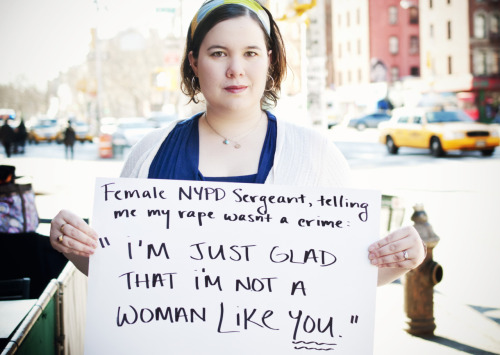
Project Unbreakable

Unbreakable

Thanks to a friend who tipped me off to this project, using photography as a way to help survivors of sexual abuse/assault.   She photographs survivors with quotes from their perpetrators.  Recently, people have been taking pictures of themselves and their quotes and sending them to Grace from all over the country.  Read more about it below:

Taken today. 
This woman, moments after her rape last year, had to scream and cry on a public street just so the police would actually take her to the precinct - they wouldn’t because they told her what happened wasn’t a crime. 
This is the excerpt from her email she sent me, before we met up:
There was one female officer, a sergeant, who responded to my 911 call that night. I truly thought, She’s a woman, maybe I can get through to her, woman-to-woman. As the police tried to escape to their cars and leave me weeping pantyless on the sidewalk, I followed her, begging with her to listen to me. I said to her something like, “Please, please help me… Imagine as a woman what this must feel like for me…”
The quote on the poster is what the female sergeant replied.
—
On a different note, this is going to be the last photo until the weekend is over. This project is tough to manage, but it’s probably also tough to read as well. I think it would be good for all of us to take a couple of days to just breathe. Okay? Okay. No clicking onto the site, either. Just take some time for yourself. 
xo
Grace
—
Edit: The rest of Meredith’s story.. 


In October of last year, Grace Brown began a photography project called Project Unbreakable. Grace uses photography to help heal sexual abuse survivors by photographing them with posters that hold quotes from their attackers. Rape survivor and advocate for victims of sexual abuse, Yvonne Moss, describes the project as a way for victims to take the power back of the words that were once used against them. 

 Grace plans on photographing survivors for as long as she possibly can. Her goal is to spread light, awareness, and healing for those who have been affected. 

If you are interested in participating by either being photographed or sending in your own image, you may send her an email at projectunbreakable@gmail.com with the subject line "Photograph Me" or "Submission", depending on the circumstance. 


If you have an image you would like to submit, please email me at grace@50extraordinarywomen.com  And if you’re in NYC, MA, NJ, or Washington DC then I would potentially be able to photograph you in the near future - just send me an email.


Sunday, January 22, 2012

More than origami...

AWESOME THING OF THE DAY: Cities Made Of Paper
January 22, 2012

Dutch artist Ingrid Siliakus makes shapes out of folded paper, but she's not just another origami hobbyist. (Although she can probably whip off a pretty awesome crane in no time.)

 Instead, Siliakus makes incredibly detailed and fantastical cityscapes, which look like pages from the most amazing pop-up book you can imagine.

Some of Siliakus's work will be on display until February 29 at Erve Kots in the Netherlands.

POSTingridsiliakuspaperarchitecture2.jpgPOSTingridsiliakuspaperarchitecture4.jpg

POSTingridsiliakuspaperarchitecture5.jpg

POSTingridsiliakuspaperarchitecture6.jpg

POSTingridsiliakuspaperarchitecture7.jpg

POSTingridsiliakuspaperarchitecture10.jpg

POSTingridsiliakuspaperarchitecture12.jpg

POSTingridsiliakuspaperarchitecture3.jpg

Friday, January 20, 2012

Autism Definition Could Change in New DSM-V

As an art therapist who works with some teens diagnosed with Asperger's Disorder or high-functioning Autism, this could make a big difference in the field of psychology:


Proposed changes to the definition of autism might make it much harder for a person to be diagnosed with the disorder. The change would likely slow the rapidly increasing rate of autism diagnoses but also spark fears that some children with autism would no longer fit its definition, excluding them from services and treatments they depend on. 

A panel of experts from the American Psychiatric Association re-evaluating the definition currently published in the “bible” of psychiatry, the Diagnostic and Statistical Manual of Mental Disorders, which is used to determine treatment, insurance coverage and access to services for a variety of mental illnesses. 

That definition includes a number of disorders under the umbrella of autism spectrum disorder, including autism disorder, Asperger’s disorder and pervasive development disorder not otherwise specified, which usually includes people who don’t fit neatly into the other categories of autism. Currently, people must show at least six out of 12 possible behaviors to be diagnosed as autistic. 

According to a report published Wednesday in the New York Times, proposed changes to the definition for the new DSM edition, slated to be published next year, would exclude Asperger’s and PDDNOS and consolidate autism diagnoses under a narrower category of autism. The person would have to show three deficits in social interaction and communication and two repetitive behaviors, a stricter set of criteria. 

Many autism experts support the proposed changes, saying they will make it far easier to diagnose autism. 

“Distinctions between the current subtypes are difficult to make, and do not necessary have differential implications for treatment. The line between PDDNOS and autism is often blurry, as is the line between Asperger’s disorder and ‘high functioning’ autism,” Wendy Stone, director of the University of Washington Autism Center, told ABC News. “Even well-trained researchers and clinicians using standardized measures may not agree on which side of these ‘lines’ an individual may fit.” 

Experts say the changes will probably also arrest the rate of autism diagnoses, which have been rising sharply in recent years. The Centers for Disease Control and Prevention estimates that one in 110 children in the U.S. has autism under the old definition. 

Dr. Fred Volkmar, director of the Child Study Center at the Yale School of Medicine, led a team of researchers who analyzed data from a 1994 study testing the criteria used in the current edition of DSM. According to a statement from Yale University, the researchers found that half of the people diagnosed with autism in that trial would no longer merit a diagnosis under the new proposed criteria. In the statement, Dr. Volkmar emphasized that these preliminary findings suggest that “only the most cognitively able” would be excluded from an autism diagnosis. 

Lori Warner, director of the Hope Center for Autism at Beaumont Children’s Hospital Center in Royal Oak, Mich., told ABC News that these cognitively able, ‘high-functioning’ autistics still require a number of treatment and support services. “People tend to think that the more severely impacted children need the most services. But often these high-functioning individuals with enough help could either move out of the spectrum or live more functional lives with dignity,” Warner said. “If the Volkmar group is correct, I’m very worried for that segment of families.” 

If patients lose their diagnosis status, they might not be able to get the treatments and services provided for autistic patients and their families, which often require a diagnosis to qualify for insurance coverage, special education and other assistance. “Really, in a lot of states, you need that diagnosis in order to have treatment covered. If you don’t have that diagnosis, you’re going to try to pay out of pocket or you have no access to these services,” Warner said. “It could be devastating for a lot of families.”


video platformvideo managementvideo solutionsvideo player video platformvideo managementvideo solutionsvideo player

Monday, January 09, 2012

HRH The Duchess of Cambridge becomes Royal Patron of The Art Room

Today I discovered that The Duchess of Cambridge (nee Kate Middleton) narrowed down her selection of 4 charities to include an art therapy program in the UK, inspired after visiting an art therapy suite in a Montreal hospital. 


Art therapy 
Despite protests outside, Kate and William were all smiles as they arrived at Montreal's Sainte-Justine University Hospital. They visited a 10-year-old kidney transplant patient in the art therapy suite. 


We are delighted to announce that HRH The Duchess of Cambridge became Royal Patron of The Art Room on 5 January 2012. Director and Founder Juli Beattie said, “On behalf of all of our Trustees and staff and the children and young people we support, I want to thank the Duchess for choosing The Art Room. It is a fantastic endorsement of the work we do and the role that art and creativity can play in helping children and young people whose start in life has been difficult.”

Click here to read more about The Art Room and the Duchess' Patronage.


 Kate Middleton is greeted by dozens of cheering children as she arrives at The Art Room charity, which uses art therapy to tackle issues such as low self-esteem and Asperger syndrome in young people. The Duchess who became patron of The Art Room in the new year, met staff from Rose Hill Primary School, Oxford. Also waiting to greet her was Mark Thompson, director-general of the BBC and a trustee of The Art Room. Juli Beattie, founder and director of the charity, which celebrates its 10th anniversary next month, said the organisation had been “absolutely overwhelmed” by the Duchess’s decision to support it. She said: “The Duchess is a highly-intelligent young woman who wants to make a difference. We wrote a letter asking for her support, but she had already done her own research into art therapy before that.”


Saturday, December 31, 2011

Artwork of Soldiers Through the Last Century

An exhibit (now unfortunately over) was presented in Philadelphia regarding the art of the military while they have been away at various wars.  Although this wasn't formal art therapy, it appears to be art as therapy, and a way of documenting moments that were likely difficult to put into words.  Working in a military environment shows me that this is not new, and that art will be a longstanding need for those serving in the armed forces, as well as with their families.

Dramatic artwork by US soldiers shows a century of war through their eyes 
By DAILY MAIL REPORTER
Last updated at 6:31 PM on 31st December 2011

Since the first Americans marched off to fight the British for independence, soldiers have been chronicling US wars with paintings and drawings that show the conflicts from the perspective of the troops on the ground. 

Here are just a few of the 1,500 works of art by servicemen and women that were on display at the National Constitution Center in Philadelphia as part of their Art of the American Solider exhibition. Beginning with portrayals of trench warfare in World War I, the artworks cover every American conflict through the wars in Iraq and Afghanistan. 

Some are simple displays depicting the boredom and monotony of everyday life in the military. Others show darker truths about war -- portraits of combat's stress, trauma and weariness etched into the faces of servicemen. The art also often shows the ruination that war brings to a landscape and the people around it -- burned out buildings and devastated families. 

Artistically, they run the gamut from realism to abstraction. However, most of the works tend to have more literal and less obtuse interpretations. The exhibit was launched in the fall of 2010 to coincide with American combat troops beginning to return home from Iraq. It ran until March 2011. 


Wednesday, December 14, 2011

Musicians use divergent thinking more often than non-musicians

I came across this article via a colleague and though it's a few years old, it still seems relevant. Even though the focus is specifically with musicians, I wonder if some of the same principles are true for any of the other arts as well.

Musicians use both sides of their brains more frequently than average people
Posted on Thursday, Oct. 2, 2008 — 4:14 PM

Supporting what many of us who are not musically talented have often felt, new research reveals that trained musicians really do think differently than the rest of us. Vanderbilt University psychologists have found that professionally trained musicians more effectively use a creative technique called divergent thinking, and also use both the left and the right sides of their frontal cortex more heavily than the average person.

The research by Crystal Gibson, Bradley Folley and Sohee Park is currently in press at the journal Brain and Cognition.

“We were interested in how individuals who are naturally creative look at problems that are best solved by thinking ‘out of the box’,” Folley said. “We studied musicians because creative thinking is part of their daily experience, and we found that there were qualitative differences in the types of answers they gave to problems and in their associated brain activity.”

One possible explanation the researchers offer for the musicians’ elevated use of both brain hemispheres is that many musicians must be able to use both hands independently to play their instruments.

“Musicians may be particularly good at efficiently accessing and integrating competing information from both hemispheres,” Folley said. “Instrumental musicians often integrate different melodic lines with both hands into a single musical piece, and they have to be very good at simultaneously reading the musical symbols, which are like left-hemisphere-based language, and integrating the written music with their own interpretation, which has been linked to the right hemisphere.”

Previous studies of creativity have focused on divergent thinking, which is the ability to come up with new solutions to open-ended, multifaceted problems. Highly creative individuals often display more divergent thinking than their less creative counterparts.

To conduct the study, the researchers recruited 20 classical music students from the Vanderbilt Blair School of Music and 20 non-musicians from a Vanderbilt introductory psychology course. The musicians each had at least eight years of training. The instruments they played included the piano, woodwind, string and percussion instruments. The groups were matched based on age, gender, education, sex, high school grades and SAT scores.

The researchers conducted two experiments to compare the creative thinking processes of the musicians and the control subjects. In the first experiment, the researchers showed the research subjects a variety of household objects and asked them to make up new functions for them, and also gave them a written word association test. The musicians gave more correct responses than non-musicians on the word association test, which the researchers believe may be attributed to enhanced verbal ability among musicians. The musicians also suggested more novel uses for the household objects than their non-musical counterparts.

In the second experiment, the two groups again were asked to identify new uses for everyday objects as well as to perform a basic control task while the activity in their prefrontal lobes was monitored using a brain scanning technique called near-infrared spectroscopy, or NIRS. NIRS measures changes in blood oxygenation in the cortex while an individual is performing a cognitive task.

“When we measured subjects’ prefrontal cortical activity while completing the alternate uses task, we found that trained musicians had greater activity in both sides of their frontal lobes. Because we equated musicians and non-musicians in terms of their performance, this finding was not simply due to the musicians inventing more uses; there seems to be a qualitative difference in how they think about this information,” Folley said.

The researchers also found that, overall, the musicians had higher IQ scores than the non-musicians, supporting recent studies that intensive musical training is associated with an elevated IQ score.

The research was partially supported by a Vanderbilt University Discovery Grant.

Folley is a postdoctoral fellow. Park is a professor of psychology and psychiatry and a member of the Center for Integrative and Cognitive Neuroscience. Gibson was an undergraduate student and research assistant in the psychology department at Vanderbilt when this work was conducted and is now a Peace Corps volunteer based in Namibia. Park and Folley are Vanderbilt Kennedy Center for Research on Human Development investigators.

Tuesday, December 06, 2011

Unsurprisingly, the Arts makes people happy!

I came across this article recently, and discovered that according to this data gathering, when ranked, of the top 6 activities that create the most happiness, #3-6 are all rooted in the arts - drama/theater, music, and art (viewing and creating). But of course, we already knew this! :)

Art and Happiness: New research indicates 4 out of 6 happiest activities are arts-related (!)
December 2, 2011 By Clayton Lord

Last week, an article that was actually published nearly a month ago on Chatelaine.com passed through my Facebook feed four times in two days. The article, titled “The three times people are happiest—you may be surprised,” rather vaguely discussed a research project out of the London School of Economics that was mapping happiness levels associated with various activities—and the results, per the article, indicated that, behind sex and exercise, the next most happiness-inducing activity was attending the theatre.

This landed with a big thud inside my head, as it sits so squarely next to a lot of the work we’re trying to do to understand the impacts, effects and benefits of the arts beyond the economic, so I did a little research and discovered that the project is called the Mappiness Project and it is the graduate work of an LSE researcher named George MacKerron. And I emailed him, he emailed back, and we chatted briefly.

So here’s the shocker—the Chatelaine article, and the Marie Claire article it’s based on, left out potentially the most amazing part of MacKerron’s (very preliminary) results so far. Of the top six most happiness-inducing activities, again after sex and exercise, the other four are all arts-related. They are, in descending order:

1) Intimacy/making love
2) Sports/running/exercise
3) Theatre/dance/concert
4) Singing/performing
5) Exhibition/museum/library
6) Hobbies/arts/crafts

MacKerron’s research, which relies on an iPhone app that randomly dings at you twice a day and has you take a short survey on your happiness and alertness, has garnered three million data points from 45,000 users in the UK over the last 18 months. And it’s important to point out that, of those 3 million responses, only 3,500 were in the theatre/dance/concert category (about .3%). But, and this is important, those 3,500 people who responded during or immediately after that activity were demonstrably happier. The way McKerron put it to me, “Someone at the theatre will average about 6 points happier than someone who isn’t.” (It’s on a scale of 0 to 100, with 0 being completely unhappy and 100 being completely happy). This, compared to someone having sex, who averages 12 points happier than someone who isn’t, and I see a new ad campaign.

MacKerron and his co-researcher/advisor, Susana Mouranto, are (at least for now) particularly looking at the impact of the environment around an individual on their happiness, and so as part of that they have attempted to control for confounding variables in an attempt to ensure that they’re actually measuring the happiness induced by the event of that moment, and not the general happiness level of the individual. In this case, MacKerron is intrigued by the theatre result in part because theatre attendance requires advance directed action (i.e. you have to buy a ticket), so that tends to mean that he feels more comfortable extrapolating that they’re happier because they’re in the theatre, and not in the theatre because they’re happier. He has more trouble with such conclusions in places like parks.

Survey responses that come in more than an hour after the solicitation are discounted in an effort to ensure that people are actually recounting their happiness levels as accurately as possible (and, at the same time, to be realistic about allowing a person to finish up (ahem) whatever activity they’re doing at the time). And so, in this way, MacKerron’s work isn’t really about long term echoes of an experience—more instant gratification than long-term emotional health. Which is in itself interesting. And, while he didn’t have the demographic data in a useable form when he chatted with me, he does have demographics on the respondents as well as relatively-accurate GPS location tracking of where people were when they responded, which spark two ideas in my head: such research has the possibility of (1) helping us better understand if our work is differently-affecting different people and (2) allowing us to actually map of particular events (or organizations) are instigating higher happiness scores in general.

All in all, MacKerron’s work, which he’s also discussed in a TEDx talk, has a lot of potential to tell us more about what role the arts play in the emotional well-being of individuals—and I can’t wait for him to begin publishing his work, which is in process.

Across all types of theatre work (see (very preliminary) graph), our research into intrinsic impact indicates that captivation (i.e. getting lost in the work and losing track of time) and emotional resonance are particularly affecting impacts with theatre.


In this sense, then, perhaps another word for captivation (especially in context with sex and exercise) might be euphoria, which Webster’s dryly defines as “a feeling of well-being or elation,” and Wikipedia more colorfully defines as “a medically recognized mental and emotional condition in which a person experiences intense feelings of well-being, elation, happiness, ecstasy, excitement and joy.”

Six points happier. Six points, I would argue, healthier. That’s awesome data, and I can’t wait to see more.

Monday, December 05, 2011

A New Meaning to Pointillist Art...

ARTS AND ENTERTAINMENT

AWESOME THING OF THE DAY: Candy Sprinkles Photography
November 30, 2011

This "photograph" isn't a photograph: it's actually a painstakingly created piece of pointillist artwork. And it's made of candy.

pointillistdogfeature.jpg

We spoke to Joel Brochu, the Canadian artist and student at the University of Regina in Saskatchewan who created this brilliant piece of candy art. It took him a long time - Joel spent nearly eight months placing 221,184 nonpareils sprinkles (circular candy sprinkles that are used in cake and doughnut decoration) on a four foot by 1.5 foot board using double-sided tape.

Joel didn't actually take the photograph the artwork is based on: "The photograph from which I worked was taken by Shingo Uchiyama, a Japanese photographer. I stumbled on his work when searching for the perfect image to use and absolutely fell in love with his beagle. He granted me permission to use it."

In order to go from photograph to candy mosaic, Joel ran the original pic through a computer program that breaks down images into essential colours. According to the artist, "the difficult part was matching the computer colours to the actual colours of the nonpareils", which is not surprising, since he only had six colours of candy to work with. That's right: the artwork only contains six colours. The photorealistic effect is achieved by visual colour blending when it's viewed from a distance.

And as if all that wasn't impressive enough, how about this? Joel's not even majoring in fine arts. He told us he was studying art for a few months, but decided to make a change: "I have settled on religion and Eastern philosophy, another interest I have had since childhood". It seems he's already stumbled on an effective form of meditation.

Here are some close-ups that reveal the details of Joel's work of art.

pointillistdetailfeature1.jpg

pointillistdetailfeature2.jpg

pointillistdetailfeature3.jpg

Sunday, November 20, 2011

Guest Blog: Fabric Meditation

I was honored to have a request from Allison Brooks to be a guest blogger here on "Adventures in Art Therapy." She describes herself as "very passionate about enlightening people about the benefits natural and integrative therapies can have on multiple diseases and illnesses." As a result, she wrote a very timely article on the benefits of art therapy - specifically fabric arts with quilting - with those who suffer from cancer. A little bit about Allie - she attended the University of Mississippi and earned her degree in Biomedical Anthropology. She is now studying in the field to finish an ethnography on the effects of biomedicalization on Bolivian Cultures. Please enjoy her contribution!


The Art of Therapy

How art and medicine are working together

From the dawn of man, art has been used as a way to release creativity, tell a story, decorate hallways, and maybe poke fun of an enemy. But no matter what, art is a visual or verbal way to express a person’s emotions, character, and insight; basically an extension of the artist. Even though it seems like a way to pass time, to make a gift, or continue a hobby, art is making its debut in hospitals all around the world as a way to manage stress and release feelings during cancer treatments.

Though cancer is a physical issue, it is very common for cancer patients to encounter severe emotional and psychological malaise. This is where art therapy comes into play. Dr. Josee Leclerc, who has a private practice for art therapy, states, “Art therapy really allows for an expression that words would not. The goal is to allow for emotions that are too difficult to put into works, or to use the image as a mirror or a witness of what the person is feeling, experiencing, or going through.”

The most notable of the cancer art therapies are the quilting projects. There have been multiple quilting programs in hospitals around the United States. Deborah Theriault has been facilitating quilting projects in the major cities of New Brunswick for years and stated, “This form of therapy gave them an avenue that changed their focus and spiritually took them away from their hospital beds and away from their sickness.” These quilts then go on to be a testament of their battle for survivors, and for the patients that did not survive, the quilts become a fond memory for the families.

Lin Swensson is another quilt therapist which travels to different hospitals to offer lessons. She encourages patients to either paint their stories on swatches of fabric or use pieces donated by local fabric stores. Patients find the quilting very therapeutic and often make quilts for one another. One lady, named Kate Graves, said that the quilts were “something tangible that could express far more than a get-well card.”

“Building Blocks” Kate Graves

Though this form of art therapy is not considered a form of cancer treatment, it is gaining a solid reputation as an alternative way to rehabilitate cancer patients. Many doctors recommend patients diagnosed with a low-survivability rate or aggressive cancer, such as non-Hodgkin’s lymphoma or pleural mesothelioma, to look into a form of art therapy. Even though every cancer is a serious cancer, the ones with the harsher treatments drain the person of morale quicker. Art therapy is not only an escape from the typical treatment routine, but it also improves self-esteem and gives the patient a sense of control when it seems out of reach.

Saturday, November 12, 2011

Brain surgery triggers compulsive artmaking

I came across this program on TV about "Ingenious Minds," and this one particular program followed the case of a chiropractor who had to have brain surgery to unwrap blood vessels that were pinching a nerve near his ear. After some complications from the surgery, they had to remove part of his cerebellum to ease some swelling. As a result, he encountered some side effects, such as double vision, difficulty with balance, and....the compulsive need to create art. Neuroscientists are now studying his brain makeup to see how the structure of his brain is linked to creativity. Watch the episode below:


Jon Sarkin was a successful chiropractor until he suffered a brain aneurysm while golfing. While in surgery, Jon died on the table and doctors had to remove nearly half of his cerebellum to save his life. Jon couldn't walk or talk for a year and he started drawing and painting as a way to communicate.

For Jon, making art isn't an option: it's his life and his curse. Jon's condition is a rare one known as "acquired savant syndrome." Some of the world's most esteemed neurologists want to study his brain to understand his sudden compulsion to create art.

The researchers discover that Jon's brain re-wired itself after the trauma. Functions that the cerebellum usually controls (motor control, attention span) have been re-routed to the frontal lobe, which usually handles high-level functions like abstract thinking, decision-making and creativity.

Friday, November 04, 2011

Art Gallery Cleaner Unknowingly Scrubs Artwork

In the world of art in general...

Art Gallery Cleaner Destroys Artwork worth $1,118,000

There's a lot to be said for keeping a space clean and tidy. But when that space happens to be an art gallery, you have to be careful what you're sanitizing. An overzealous cleaner at a German gallery found that out the hard way when she ruined a sculpture valued at €800,000 (CAD$1,118,650) because she thought it was dirty.

The artwork, which was created by German artist Martin Kippenberger who died in 1997, was called 'When It Starts Dripping From the Ceiling'. It featured a rubber trough placed under a wooden tower, with paint inside the trough meant to represent dried rainwater. The cleaner obviously thought it was just dirt, and managed to remove it all with a scouring brush.

This isn't the first time a work of art has been mistaken for something that needs to be cleaned up. In 2001, an installation by British artist Damien Hirst was swept up and thrown away by a cleaner at the Eyestorm gallery. Of course in that case, the "art" in question was a room full of ashtrays, half-filled coffee cups, empty beer bottles and newspapers, so the cleaner could be forgiven. The artist himself found the whole thing "fantastic. Very funny."

Other artworks have been lost or damaged this way, including a so-called "grease stain" by Joseph Beuys which was apparently valued at about $557,000, and a work by artist Gustav Metzger at the Tate gallery in Britain that included - you guessed it - a bag of trash. Apparently the old saying/cliché is true: one man's trash really is another man's treasure.