Young Pain From Japanese Disasters Eased By Artmaking
By:Lindsey Christ
After the tsunami washed away their homes, schools and sometimes even their parents, many Japanese children were encouraged to draw pictures about their feelings. Now their art has come to New York and local students are responding. NY1's Education reporter Lindsey Christ filed the following report.
Crayons can sometimes help children heal. For the youngest survivors of the recent earthquake and tsunami in Japan, art has been a key to recovery. This week, some of their drawings came to New York City, as the first stop of an international tour.
Drawings and writings by more than 300 Japanese students are on display through Friday at the AIGA National Design Center on Fifth Avenue near 22nd Street in the Flatiron District.
The children's pain is clear. One 10-year-old child wrote, "I was worried about school -- what about aftershocks? This is how I felt deep inside. It was scary. That's all. My heart is so anxious."
The non-profit group Hug Japan visited more than 100 schools along the tsunami-ravaged coast. Workers noticed lots of material donations but not much psychological support.
"Nothing to help children in their mind, so teachers didn't know how to encourage the children," says Hug Japan representative Kazunari Matoba.
That's where the art therapy came in. Students were told to focus on either how they feel now or what they hope for the future. As part of the exhibit, New Yorkers can respond by drawing or writing postcards to the children.
Students at schools like Harlem's Manhattan East Middle School raised money and drew their own responses.
"New York is suffering from the 9/11 and also New York is a special place for art," says Hug Japan representative Kazunari Matoba. "Maybe Japanese students will be encouraged by New York children's art."
The art therapy of photographer Mayumi Suzuki hangs opposite the student drawings. She lost her home and both parents to the tsunami.
"After the earthquake, I did not know what I can do. However, by picking up the camera, I was able to take a step forward. And I believe that it is because I have the camera that I can keep going," says Suzuki.
Photographing the students, she says they looked depressed in the beginning, but seemed uplifted after turning to art.
As an art therapist and a musician - I completely am on board with what our sister field of music therapy is doing. Sharing a report of its success here:
Music Therapy Can Calm Agitation, Relieve Depression
By: LAIRD HARRISON, Internal Medicine News Digital Network
05/24/11
SAN FRANCISCO – Music therapy can improve symptoms of depression and agitation in residents with dementia, according to researchers who described an innovative program in the Metropolitan Jewish Health System in New York.
"There was a major drop in agitation after 2 weeks of music therapy," said Dr. Mary S. Mittelman, director of the psychosocial research and support programs at nearby Langone Medical Center, and statistical analyst for the pilot program. "Depression went way down."
While most nursing homes offer music as passive entertainment, the researchers tried to systematically engage residents as active participants who move in time to the music, sing, or play instruments.
Music may stimulate people with dementia in a way that language cannot, said Jan Maier, RN, of the Research Triangle Institute International in Durham, N.C., who offered background information on music therapy. "In dementia, the parts of the brain that have to do with music and emotional memory are preserved," she said.
She cited anecdotal reports of people with dementia learning three-part rounds or recalling the words to long hymns they sang in their youth. In some documented cases, former professional musicians with such severe dementia that they couldn’t dress themselves have been able to play instruments in ensembles, she said.
"People who don’t remember their son or daughter who come to visit will remember the person who leads their music group, and say, ‘Do we have music today?’ " Ms. Maier said.
Photo courtesy Metropolitan Jewish Health System
Music therapist Michael McGaughy is shown engaging a resident as an active participant in a music program, which some studies have found helps patients with dementia and agitation.
A handful of randomized controlled trials have shown reductions in agitation in patients with dementia who participate in music therapy, she said, citing among other studies one by researchers in Taipei, Taiwan, that recently documented the effect (Int. J. Geriatr. Psychiatry 2011 July;26:670-8 [doi: 10.1002/gps.2580]).
Music therapy has great potential in long-term care, Dr. Mittelman said, since about 70% of nursing home residents over age 75 years suffer from dementia.
The Metropolitan Jewish Health System developed protocols in which the residents sang along or moved in time to the music, and others that incorporated music into activities of daily living, such as wound care, bathing, and range-of-motion exercises.
In a video demonstrating a typical session, women waved scarves in time to big band music. "The movement intervention worked best," said Kendra Ray, an art therapist who directed the project.
Dr. Mittelman said the researchers collected data on 84 people, of whom 8 had agitation, 42 had depression, and 34 were wanderers. The research showed an average one-third drop on the Cohen-Mansfield Agitation Inventory and a similar improvement in depression, measured by the Dementia Mood Picture Test. Depression returned when the music therapists left and certified nursing assistants took over the activities. Results from the Algase Wandering Scale were inconsistent. Dr. Mittelman acknowledged that the data were only preliminary and that larger studies should be conducted.
But, as another measure of success, Dr. Mittelman said that some of the participants’ families testified about the benefits of the program. Some said that they enjoyed their visits more because the residents’ moods had improved so much. "My Mom is more upbeat, more attentive, and talkative," one wrote. And, at times, residents picked up instruments to practice on their own, outside of music-therapy hours.
If you are trying to address specific behaviors, Dr. Mittelman advised, time the therapy for when these behaviors are likely to occur. For example, if someone wanders in the evening, play music at that time. But don’t play music all day. That can become irritating, she said.
When designing a music-therapy program for an individual, "Pick the music that person loved," Dr. Mittelman said. "If you don’t know, go to their early adult years. If they like it, they’ll let you know right away."
Dr. Mittelman and Ms. Ray said they had no conflict of interest on the topic.
So this has been a while in coming...but I finally finished up my art therapy store with merchandise that gives you options of sharing art therapy in a number of different ways! I also added some items with some of my personal artwork as well, if you are just looking for something artistic to have around. Here are a few samples below!
A friend of mine clued me in to this art by British graphic designer Patrick Smith. This is a great combination of art and psychology, and I wanted to share it with you!
Art therapists believe that through creative expression and by evoking one’s imaginative abilities a person can live a greater life of physical, mental, and emotional well-being.
Depending on the patient’s strengths and interests, certain art therapies may include any combination of dance, drama, music, writing, embroidery, and the visual arts (drawing, painting, sculpting and photography).
Through these expressive mediums it has been shown that patients become better at reducing stress, managing behavior, developing interpersonal relationships, increasing self-esteem and self-awareness, improving problem-solving and other cognitive faculties, as well as achieving insight.
The arts have probably been used as a source of healing ever since they have come into existence; but art therapy did not emerge as a distinct profession until the 1940s where psychotherapists began to take interest in the creative output of those with mental illnesses (such as the famous Mexican artist Martin Ramirez who was diagnosed with schizophrenia) as well as those on psychedelic drugs (such as this government-mandated study on LSD).
More amazingly, PBS’ Wide Angle, Focal Point documentary did a segment on how art therapy has even been used to reform terrorists (out of over 200 patients who have completed the program only 5% have relapsed!):
As an art therapist and a musician, I completely understand the power of music therapy. (I've even thought about going back to school for a music therapy degree, but the opportunity hasn't presented itself yet.) Here's some great reports about our cousin in the creative arts therapies.
TUSCALOOSA, Ala. (WIAT) Listening to music can put you in a good mood, but on-going research proves it can literally improve a person's overall health.
On-going research has shown that playing live, structured and uncomplicated music for infants can decrease heart rates, increase oxygen intake, lower cortisol levels and facilitate development. Certified practitioners say music therapy can sometimes reach patients in ways other therapies cannot.
The University of Alabama is the only school in the state offering a degree in Music Therapy and as CBS 42's Leigh Garner reports, the benefits of a good song could be life changing.
The University of Alabama is the only school in the state with a program and degree for Musical Therapy. Department heads and professors run clinicals at various facilities as part of the degree requirements and to further their research. In recent studies they have discovered playing live, simple, and structured music can actually lower stress levels in adults and children. In premature babies, musical therapy also decreases the amount of time many infants must stay in the hospital. Practicioners say the difference musical therapy can make in a patient's life is visible and recognizable, while it can also provide financial benefits for hospitals and insurance providers.
September is Childhood Cancer Awareness Month. Every day in the United States, 46 children are diagnosed with cancer. One
out of five don't survive treatment, but music is helping young patients heal emotionally and physically.
Eleven-year-old Alex Harkins has been coming to Texas Children's Hospital since before she could talk.
"I had a tumor on my liver," Harkins told Ivanhoe.
Doctors removed it, but during follow up visits, she discovered a special place here -- a recording studio where kids write down their feelings and put them to music.
"Anything that kids can do that brings them joy helps to boost their immune system," Anita Kruse, founder of Purple Songs Can Fly at Texas Children's Hospital in Houston, Texas, explained.
Research shows music helps calm patients during procedures, promotes relaxation and sleep, and reduces pain and treatment side effects. Harkins has been cancer free for ten years. Her message to other kids
"Don't give up now matter how hard it gets," Harkins said.
Children from around the world have recorded in this studio. Their songs are heard played on Continental Airlines flights. The music recorded at the studio has also flown into space. One of the NASA astronauts took two of the CDs on a shuttle mission to the international space station.
Helen B. Landgarten dies at 89; pioneering art therapist
The L.A. painter established a clinical art therapy program combining art and counseling at Cedars-Sinai Medical Center and graduate departments at two schools.
By Claire Noland, Los Angeles Times
February 26, 2011
Helen B. Landgarten, a Los Angeles artist and pioneering art therapist who established a clinical art therapy program at Cedars-Sinai Medical Center and graduate departments in art therapy at Immaculate Heart College and Loyola Marymount University, has died. She was 89.
Landgarten died Wednesday at Ronald Reagan UCLA Medical Center after suffering a stroke, Loyola Marymount announced.
In the 1970s, Landgarten helped legitimize art therapy, which combines art and counseling, on the West Coast. Practitioners say that art therapy can be an effective diagnostic and treatment tool during psychotherapy sessions, particularly with children, adolescents, families and groups.
"I can have a family create some art together and in about a half-hour, by the way they have proceeded — who went first, who went last, the whole mechanism, observing all that — I could tell you what the family system is, what role each person played, how they functioned as a unit," Landgarten said in a 1986 interview with The Times. "Now when people come to a clinic, they don't push and shove each other like they might at home. You know people are on their best behavior, so the art can be symbolic of what happens in their daily lives."
Art also provides mental health patients with a positive, creative outlet and allows them to communicate with others in nonverbal ways, Landgarten said. And the art produced is tangible evidence of the effort made in the treatment process.
A painter, she earned a bachelor of fine arts degree at UCLA in 1963. She was drawn to psychotherapy in the 1960s and '70s, said Debra Linesch, chairman of the graduate department of marital and family therapy at Loyola Marymount.
"As a painter, she recognized the deeper connection between art and the unconscious, one's own inner life," Linesch said in an interview Friday.
Landgarten earned a master's degree in marital and family therapy at Goddard College in Vermont in 1972 and introduced a clinical art therapy practice to Thalians Community Mental Health Center at Cedars-Sinai.
In 1976, she founded a master's degree program in art therapy at Immaculate Heart College in Los Angeles, the first of its kind on the West Coast. After the college closed in 1980, she moved the program to Loyola Marymount. She directed the program and taught courses until 1988, when she retired.
She was the author of academic textbooks, including "Clinical Art Therapy," "Family Art Psychotherapy," "Adult Art Psychotherapy" and "Magazine Photo Collage."
Born Helen Barbara Tapper in Detroit on March 4, 1921, she married Nathan Landgarten in 1942. They had two children, daughter Aleda and son Marc, who survive her.
Funeral services will be at 10 a.m. Sunday at Mount Sinai Memorial Park, 5950 Forest Lawn Drive, Los Angeles.
Here is a good interview with art therapist Angelina Rodriguez about what art therapy is...a common question by those who are not familiar with the field or would like to know more.
It is everywhere you look, and everywhere you don’t look. You delight in its marvels both consciously and sub-consciously. You see color all the time, but how often do you think about its origins and effects? In a series of articles, we are going to explore this topic further. With this first article, we’ll go over some basics of color therapy and healing.
As most of you know, color is light and energy. Color is visible because it reflects, bends, and refracts through all kinds of particles, molecules and objects. There are a variety of wavelengths that light can be categorized, producing different types of light. Visible wavelengths fall approximately in the 390 to 750 nanometre range and is known as the visible spectrum. Other wavelengths and frequencies are associated with non-visible light such as x-rays & ultraviolet rays. Most people are aware of the effects of non-visible light, so it makes sense that visible light would also affect us.
One example of the way light can affect us is a mild form of depression known as Seasonal Affective Disorder (SAD), which causes many people suffering during winters.
An Introduction to Color Therapy
Color therapy and healing (also known as chromotherapy or light therapy) is a type of holistic healing that uses the visible spectrum of light and color to affect a person’s mood and physical or mental health. Each color falls into a specific frequency and vibration, which many believe contribute to specific properties that can be used to affect the energy and frequencies within our bodies.
While it is common knowledge that light enters through our eyes, it’s important to note that light can also enter through our skin. Given the unique frequencies and vibrations of various colors, people believe that certain colors entering the body can activate hormones causing chemical reactions within the body, then influencing emotion and enabling the body to heal.
Colors are known to have an effect on people with brain disorders or people with emotional troubles. For example, the color blue can have a calming effect which can then result in lower blood pressure, whereas the color red might have the opposite effect. Green is another color that may be used to relax people who are emotionally unbalanced. Yellow, on the other hand, may be used to help invigorate people who might be suffering from depression. (We’ll dive deeper into specific colors in a future article.)
Alternative therapies also believe that a person’s aura contains different layers of light which can be used for cleansing and balancing. Knowing the colors in your aura can help you better understand your spirit, and thus help you better understand how to heal. Additionally, the colors surrounding you can also have various effects.
A Brief History of Color Therapy
It’s no mystery that the sun and its source of light (or lack thereof), can have a profound effect on us. Thousands of years ago, some countries began exploring color and its healing capabilities. Egypt, Greece and China are known for their forays into color healing and therapy. A few examples include:
Painting rooms different colors with the hopes of treating certain conditions.
Utilizing colors in nature in their surroundings (blue from skies, green from grass, etc.)
Healing rooms that utilized crystals to break up sunlight shining through.
There is evidence of people attempting to use color for healing and therapy from as far back as 2000 years. And it has gained in popularity throughout the years, with numerous books being written about it, including Johann Wolfgang Goethe who studied the physiological effects of color. As we mentioned though, many people are skeptical about using color and light for healing or therapy.
Stay tuned for upcoming articles over the next few weeks where we’ll introduce color meanings and symbolism, how we see color, and the various effects of specific colors.
This is part two of a three-part series on color. Part one was Color Therapy & Healing. You can read part three: The Psychological Effects of Color, where we will delve into the psychology of some specific colors and how they might affect your everyday life.
Carl Jung, a renowned psychiatrist and proponent of art therapy, encouraged his patients to use color because he felt this would help them express some of the deeper parts of their psyche. It is believed that the color choices you make reflect a deeper meaning about your personality traits. For example, introverts and extroverts are likely to choose different colors – blue and red respectively.
The colors you choose to wear might also say something about how you are feeling that day. Some days you may fee like wearing something lighter, something red, or something blue. These choices are often a reflection of how you are feeling at the moment. Additionally, wearing certain colors may cause you to react differently to certain situations.
How Do We See Color?
There are 2 main sources of light that create the colors we see: the sun and lightbulbs. As you know, the light from the sun allows us to see things during the day as well as during the night when the sun’s light reflects off the moon. There is a visible spectrum of colors that we can see in addition to the combination of all colors (white) and the absence of color (black).
Surfaces reflect and absorb light differently, which results in the colors we see through our eyes. For example, a tomato absorbs all light on the spectrum except the red rays of light. The red rays of light are reflected off the surface of the tomato which then reach our eyes for processing.
The colored light enters the eye through the pupil, goes through the lens, then reaches the back of the eye called the retina. On the retina there are a bunch of light sensors called rods and cones. These rods and cones send a signal to the brain about what the eye is seeing. The cones are capable of seeing three colors: red, green, and blue. These are known as primary colors (RGB Model) – more about this below.
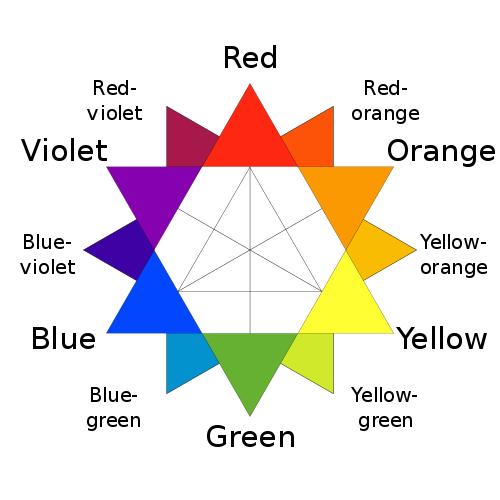
The Traditional Color Wheel – primary, secondary, and tertiary colors
Here you can see a basic color wheel. It is based on 3 different types of colors: primary, secondary, and tertiary.
Primary Colors (Traditional RYB Model)
Primary colors consist of red, yellow, and blue. These 3 hues can not be mixed or formed by any combination of other colors. Additionally, all other colors are created by mixing these three colors.
Secondary Colors
Secondary colors consist of green, orange and purple (violet). Secondary colors are formed by mixing 2 primary colors.
Tertiary Colors
Tertiary colors consist of red-orange, yellow-orange, yellow-green, blue-green, blue-violet, and red-violet. Tertiary colors are formed by mixing primary and secondary colors, resulting in the two-word names.
If you’d like to know more about RGB and RYB models, CMYK, reflective and transmitted light, then there are lots of additional sources out there that cover more in-depth color theory. These are just some basic concepts for our series on color therapy, meanings, symbolism, et cetera.
Now that we’ve covered the basics of traditional color theory, let’s review color symbolism.
What is Color Symbolism?
Color symbolism is the use of color as a representation or meaning of something that is usually specific to a particular culture or society. Context, culture and time are certainly important factors to consider when thinking about color symbolism.
Examples of Cultural & Religious Symbolism of Color
Depending on the culture or society, colors may symbolize diffferent things for different people. Consider the United States as an example. What colors come to mind when you think about traffic lights and signs? What about the flag? How about Christmas or Halloween?
Even within the United States, there are cultures that hold certain colors sacred. For example, at least 3 Native American nations hold the same three colors sacred: black, white and yellow. Although, they each have 4 different colors they hold sacred in addition to black, white and yellow.
Navajo Nation –> turquoise Apache Nation –> green Iowa Nation –> red
As was mentioned in Color Therapy, Color Meanings & Symbolism, and Color Psychology we’ve created a variety of Color Symbolism & Meanings Charts. The first color symbolism chart combines 6 of the most common colors, what they symbolize, and common meanings. We’ve also created individual color meanings charts based on those six colors. Feel free to link to this page or the charts, just follow the directions below.
We also have art & art therapy badges in a variety of sizes and colors. You can easily add these to your site or blog as well.
This first chart contains the 6 main colors (red, orange, yellow, green, blue, violet) and their popular meanings/symbolism. You can view the full color chart here, or by clicking on the image above.
The psychology of color is based on the mental and emotional effects colors have on sighted people in all facets of life. There are some very subjective pieces to color psychology as well as some more accepted and proven elements. Keep in mind, that there will also be variations in interpretation, meaning, and perception between different cultures. Studying the effects of color and how we perceive it is frequent in psychology degree programs around the world.
Applying Color Psychology to Everday Life
Did you know your surroundings may be influencing your emotions and state of mind? Do you ever notice that certain places especially irritate you? Or that certain places are especially relaxing and calming? Well, there’s a good chance that the colors in those spaces are playing a part.
In art therapy, color is often associated with a person’s emotions. Color may also influence a person’s mental or physical state. For example, studies have shown that some people looking at the color red resulted in an increased heart rate, which then led to additional adrenaline being pumped into the blood stream. You can learn more about how color therapy works and how light and color might affect us.
There are also commonly noted psychological effects of color as it relates to two main categories: warm and cool. Warm colors – such as red, yellow and orange – can spark a variety of emotions ranging from comfort and warmth to hostility and anger. Cool colors – such as green, blue and purple – often spark feelings of calmness as well as sadness.
The concepts of color psychology can also be applied in everyday life. For example, maybe you’re planning on re-painting your walls or redecorating a house or room with a new color scheme. Well, you might want to consider some of these suggestions about colors and how they might affect your emotions and mood:
Psychological Effects of Cool Colors
Need to be creative? Want help getting those brain synapses firing? Try utilizing the color purple. Purple utilizes both red and blue to provide a nice balance between stimulation and serenity that is supposed to encourage creativity. Light purple is said to result in a peaceful surrounding, thus relieving tension. These could be great colors for a home or business office.
Are you looking for a peaceful and calming environment? You might consider using green and/or blue. These cool colors are typically considered restful. There is actually a bit of scientific logic applied to this – because the eye focuses the color green directly on the retina, it is said to be less strainful on your eye muscles.
The color blue is suggested for high-traffic rooms or rooms that you or other people will spend significant amounts of time. Another cool color, blue is typically a calming and serene color, said to decrease respiration and lower blood pressure. The bedroom is a great place to use these colors as they should help you relax.
Psychological Effects of Warm Colors
Want to create an environment of stimulation or whet people’s appetite? You might consider utilizing the colors yellow or orange. These colors are often associated with food and can cause your tummy to growl a little. Have you ever wondered why so many restaurants use these colors? Now you know why even after people watched the movie SuperSize Me, they said they were hungry.
You do want to be careful about using bright colors like orange and especially yellow. They reflect more light and excessively stimulate a person’s eyes which can lead to irritation. You also probably don’t want to paint your dining room or kitchen these colors if you’re a calorie-counter.
Pyschology of Color for Marketing & Advertising
Marketing and advertising are well-known for utilizing color psychology. The fact that some companies have heavily invested in this type of research and many others have followed through in its use shows they have at enough belief in the concepts of color psychology to implement them in their advertising.
Color is consistently used in an attempt to make people hungry, associate a positive or negative tone, encourage trust, feelings of calmness or energy, and countless other ways.
Most marketing and advertising executives will likely agree that there are benefits to understanding and utilizing the psychological effects of colors. Now let’s take a look at some of the more common traits of color psychology, by some common colors.
Common Psychological Effects of Colors
The following are some common psychological effects of colors in the Western Hemisphere. You can also review the following pages for a more comprehensive list of color meanings and symbolism, including some charts we’ve created that you can download or embed on your site.
Keep in mind that certain shades or tones may result in very different meanings. Also, the context around the color, and even surrounding colors, can have an effect. Think of this as more of a beginning guide to color psychology.
As an art therapist who has worked with soldiers in the Warrior in Transition Unit (WTU), this post on The Art Therapy Blog caught my attention.
‘Art From The Heart’ Helps Wounded Soldiers
January 17th
One of our readers told us about a program at Fort Bragg, Art from the Heart, that helps wounded soldiers transition to civilian life with the help of art. Sponsored by the American Red Cross and Army Wounded Warriors Program, the program not only provides therapy to the soldiers but also aims to help them transition to, and establish, a life after the military.
Artist and veteran, Craig Bone, leads the charge for the project, utilizing his talents and connections to help the soliders. At the end of the project, Craig will give each member the opportunity have their artwork and back story published in a book.
You can also watch a video about the project here.
I haven't seen the movie yet...though I'm planning on it soon...but I was pleased to see that art therapy (also recreation and music therapy) was included in the movie "It's Kind of a Funny Story" as a part of this teen's treatment. Wonderful!
It's Kind of a Funny Story
Camerin Courtney | posted 10/08/2010 12:00
The movie starts on a bridge—both literally and figuratively. In the opening scene, distressed 16-year-old Craig (Keir Gilchrist) climbs out on a bridge. Filled with teenage angst inside and facing a crazy, messed-up world outside, Craig is overwhelmed and tempted to end it all.
When he wakes up and realizes he's just had another suicide-themed dream, and that they're getting more vivid, he also realizes he's teetering on a bridge between sanity and craziness. Afraid he's headed in a dangerous direction, he climbs out of bed without waking his parents or younger sister and bikes himself to the nearest hospital in his Brooklyn neighborhood.
After explaining to the attending physician his stress over his demanding pre-professional magnet school, his crush on his best friend's girlfriend, his forthcoming application to a prestigious summer program, his over-busy father and overwrought mother, his tendency to puke when stressed, not to mention global warming and the economy—as well as his suicide dreams and the fact that he recently took himself off Zoloft—Craig gets himself checked into the psych ward.
Keir Gilchrist as Craig
Since the teen wing is under renovation, Craig is put in with the adults for his five-day minimum stay. He's soon introduced to Bobby (Zach Galifianakis), the gregarious man-child who shows him around 3 North (the adult wing) and introduces him to the amenities (the art room, the rec room) and the locals (the doped-out, the delusional, and the delightful Noelle, a fellow displaced teen).
At first Craig is even more stressed—he was hoping for a quick cure that wouldn't keep him out of school for so long. And he's a bit freaked out by all the people who are dealing with more serious issues, like his mumbling, bed-bound roommate. Instead of rescuing him, Craig's parents arrive with some of his things and the advice to do whatever the doctors recommend.
Zach Galifianakis as Bobby
In the following days Craig attends art therapy, has meandering and meaningful conversations with Bobby, slowly opens his heart to Noelle (Emma Roberts), tries to get to the root of his issues with Dr. Minerva (Viola Davis), and tries to explain to his friends via the payphone in the hall where he is and why. It's in all these human interactions that the magic of the movie happens—the a-ha moments, the small awakenings, the baby steps toward a healthier reality.
The most compelling moments are between Craig and Bobby. Their conversations are deep and revealing without seeming too clever or overwritten. Gilchrist and Galifianakis imbue their characters with warmth, wit, and quirky charm. Only Craig's parents (Lauren Graham and Jim Gaffigan) start to veer into caricature territory with some of their classic yuppie faults.
Sure, this is a relatively sanitized look at depression and other mental disorders, but then again 3 North is a temporary facility for those who struggle. The hard-core cases would be in a more permanent location. Thankfully the film avoids some common trappings of movie mental wards—out of touch doctors, sadistic orderlies, rampant overmedication. These patients are merely people on the verge—walking that tightrope with brokenness, pluck, and yes, some only-in-the-movies charm.
Emma Roberts as Noelle
Though most of the film happens in the hospital ward, there are a couple scenes of stylization—when Craig draws some intricate city scenes that come to life and when all the patients sing a rousing version of "Under Pressure" in music therapy class and are magically transformed into a rocking music video. The latter scene is a lovely tribute to the way music and community can elevate us for a few joyful, transcendent moments.
What seeps through all these scenes is a surprising, compelling celebration of life. The film seems to be communicating that life is crazy, and those who stop—and sometimes need to check in—to acknowledge that are merely wise enough to embrace the truth and seek the help they need to navigate the maze. In the moving forward, in the coming together to help those who need it, there is hope. The film doesn't depict an eternal hope, but a hope based on friendship, love, communication, music, art, laughter, truth—some of the better things offered to us by the One who is eternal hope.
The scenes between Bobby and Craig are the best part of the film
The ending is a bit pat and over-sweet, but the voiceover kind of acknowledges that, which somehow makes it mostly okay. They can't all be tragic endings, right? The beauty here is that a movie about depression and people on the verge can be a sweet, funny, life-affirming story. And perhaps that's the funniest part about this charming little film.
Other reviews' references to art therapy in the movie:
"Accordingly, Craig’s drawings, or “brain maps,” serve as an animated entree into his vivid imagination and bring the audience more insight into the character. Inspired by the book’s original cover, Curious Pictures, a New York-based company specializing in animation, design, and graphics, produced the sequences. Animation/paintings creative supervisor Dominie Mahl recruited Brian Drucker, an artist with a background in architecture, to submit an illustration for consideration.
The animator adds, “This story affected me, so I wanted to keep a human scale and touch to the drawings. I drew by hand, then colored in with the computer and built up everything into three dimensions.” Mahl elaborated, “Given Craig’s age, we had to make sure that the work was done to display natural talent but not years of experience. Given the particular stage of his life that he’s in, the colors had to be more thoughtful than perky. This artwork comes forth as something of a revelation for Craig.”
Boden comments, “With his drawings, Craig rediscovers a hidden artistic talent-and is encouraged to do so by his fellow patients and through art therapy.”
Ned Vizzini, age 29. Los Angeles, CA. (author of the book the movie is based on)
"When I went into a psychiatric hospital for a week-long stay for depression and 'suicidal ideation' in November 2004, I found myself with a lot of time on my hands. Although I'm a writer by profession I decided to try and do abstract art. I limited my color palette and tried to just make pleasing shapes with Cray-Pas on paper. The goal was to see the colors blend well and to bring motion to the composition. I ended up really liking these drawings, and I used the art-therapy angle when I made the main character of my subsequent novel It's Kind of a Funny Story draw 'brain maps' during his own hospital stay. In a real way, these are the drawings that inspired the brain maps."
Here is a great little clip featuring an interview with America Ferrera who touts the amazing power of art therapy with soldiers! Thanks America for bringing art therapy to people's attention!
I got to attend the 41st annual American Art Therapy Association Conference that was held this year in Sacramento. It was a great conference with many good lectures I attended. One of our keynote speakers was Seena Frost, the inventor of SoulCollage, which I am looking forward to learning more about to use with my clients. I took pages of notes with information I hope will enhance my practice, and watched with pride my intern from last year present on her research project. I also got to attend a gathering of GW students and alumni. meeting some known and new faces. On the side, I got to sightsee some of Sacramento before I left.
Next year, the 42nd AATA conference will be held in my backyard, Washington DC, in July! So I'll definitely be there....
~~Click here to see pictures from the conference~~
(under construction)
Here is a video of Seena Frost introducing the SoulCollage Technique:
A retired circus chimpanzee is the Cezanne of simians, drawing crowds to a Brazilian zoo to watch him paint. The 26-year-old chimp called Jimmy has been producing surprisingly lovely paintings each day for three weeks at the Niteroi Zoo.
Trainer Roched Seba said Monday Jimmy doesn't like the toys and other diversions that other chimps enjoy. So three weeks ago, Seba introduced him to painting after reading about animals in zoos elsewhere that enjoyed a little canvas time.
Temperamental as great artists can be, Jimmy at times declines to paint if his cage is surrounded by too many gawkers.
But for at least 30 minutes a day, he carefully dips his brush into plastic paint containers and uses broad, bold strokes to create his art.
I've had the pleasure of participating in the 2nd swap of ATC's with the Art Therapy Alliance group. About 75 of us art therapists are participating this time around, creating 4 cards with the theme of "Collage Unleashed." I can't wait to get my 4 back in the mail in a couple of weeks!
Here are my 4 that I sent in:
About my cards:
1. This card is about the journey we are all on. A car traveling down a road, into the unknown journey ahead. Seize the day, sometimes it's "now or never," for the opportunity of a lifetime.
2. This card is about the healing power of art, which is why I included "painting for a cure." Art helps us "get the picture" in more ways than one!
3. The sunflower card is about growing, and in most cases, we like our growth to be secure. The flower is reaching towards the sun, soaking in the nourishment for the desired growth.
4. This card was all about the passion of art. It is a part of our soul, from which our passions come.




 Doctors removed it, but during follow up visits, she discovered a special place here -- a recording studio where kids write down their feelings and put them to music.
 kins has been cancer free for ten years. Her message to other kids