Showing posts with label art therapist. Show all posts

Thursday, March 21, 2024

Book Review: "Therapy Private Practice"

I connected with Jackie on LinkedIn as a fellow art therapist. She writes a lot of essays about various topics, such as being an art therapist, being autistic, and wisdom of how she does her work. I was delighted to receive her book on establishing a successful private practice, and wrote a brief review below.  If you are a therapist or provider of any kind, I would recommend that you check out her book to help your practice and yourself thrive!

“Therapy Private Practice: Creating a private practice that enriches you as a human and therapist” 

by Jackie Schuld, LPC, ATR-BC, REAT


As an art therapist who works in private practice part-time, this is the book I wish I had available to me when I thought about venturing into the private practice world. Rather than going solo, however, I ended up joining a group practice, which helped with a lot of the whys and wherefores I didn’t have time for or was ready to learn to do myself. I am still a part of that group practice, and it works for me since I do it very part-time on the side, but I was still quite interested to hear Jackie’s take on creating a private practice that works for you in case I decide to move over to solo practice later on.

One thing I appreciated right away was that the Table of Contents is listed both in page order and in topic order.  As a Gold/SJ, that made me very happy, especially if I want to reference something later, it will be easier to locate via topic. Topics that she covers include beginning your practice or changing what kind of practice you have, financial advice, marketing, meeting your own needs, policies that will support your practice, and even thought patterns that impact you.

Another thing that I appreciate about this book is that the chapters are short essays that are very readable.  Sometimes it’s hard to sit down and read a lengthy book that gets into the weeds (which can be just what we need at times), and this book gives us bite-size pieces to chew on and consider.  Jackie makes it clear that she is your cheerleader in making a practice that helps you – as well as your practice – to thrive.

Some of the chapters are about giving permission to make adjustments to make a practice that fits you and not necessarily what other people think it should be. Others advocate for art therapy and counseling as a field and not selling ourselves short with all of our time, investment, experience, and expertise. She wants all therapists to figure out how they work best and thrive with that, even if it may not make sense at first. Things don’t have to be the status quo, and there are ways to have a successful practice without self-sacrificing so much, as people in helping professions are so wont to do. Accessing resources, finding supports, setting boundaries and limits, finding your own niche, playing to your strengths, and the like are paramount to establishing – and maintaining – a successful practice, however you may define that to be.

Part of the content that also struck me is her line drawings that illustrate the book, which I am so happy she included (as an art therapist, I think we are drawn to that), many of which remind me of Shel Silverstein’s artwork from “Where the Sidewalk Ends” and his other poems.

Jackie’s book covers a lot of cogent topics related not only to private practice work, but also work within the mental health setting that gives good food for thought. It may be time to reinvent our work so that we will not burn ourselves out and better meet the needs of our clients, which is why we went into mental healthcare in the first place.  Will everything in the book apply to you and your situation?  Probably not.  However, it is a great read that will give you different perspectives and insights that can help you be the best – and more replenished – therapist that you can be.

Thursday, February 22, 2024

Mattel Creates Art Therapist Barbie in Career Doll Series

Just discovered a new Barbie I need to get! 🎨

Out of all the professions they could have chosen for their Career Series, I'm surprised they decided to represent an art therapist!


Unbox Dreams!

Barbie® doll has added another career to the more than 250 on her resume -- art therapist! This themed playset features Barbie® therapist doll, Chelsea™ patient doll and 10 storytelling pieces to inspire role-play fun.

Product Details

With the Barbie doll art therapy playset, kids can draw up all kinds of ways to play! The themed set comes with Barbie therapist doll and a patient doll who has a unique feature -- kids can rotate the emoji on the small doll's shirt to help express her emotion. A total of 10 accessories, including an adorable kitten, art supplies and mood stickers, engage imaginations in storytelling and role-play as they explore careers in mental health. So many pieces make the set a great gift to inspire dreams and imaginations in kids 3 years old and up. Dolls cannot stand alone. Colors and decorations may vary.

  • Barbie doll expands her resume of 250+ careers with this art therapy playset that lets kids explore a career in mental health!
  • The playset comes with Barbie therapist doll, a toddler small doll and a pet kitten, plus accessories and features to engage kids in storytelling!
  • Interactive action adds to the role-play fun kids can rotate the emoji on the patient's shirt to switch up the expression and help her talk about her feelings!
  • There's a comfy bean bag chair for the small doll, and Barbie doll can bend her knees to sit criss-cross applesauce on the floor!
  • Additional pieces encourage imaginative play like a child's painting, paint palette, paintbrush, scissors, glue bottle, tablet and pencil -- use the mood stickers on the mini cardboard chart for even more self-expression!
  • With so many ways to play, the Barbie art therapist playset makes a great gift for kids 3 years and older, especially those who love music and arts!
~~~~~~~~~~~~~~~~~~~~~~~~~~~~~~~~~~~~~~~~~~~~~~~~~~~~~~~~~~~~~~~~~~~~~~~~~~~~

Well, I finally got my Art Therapist Barbie!

She is on my bookshelf in good company with my Bob Ross Funko Pop.


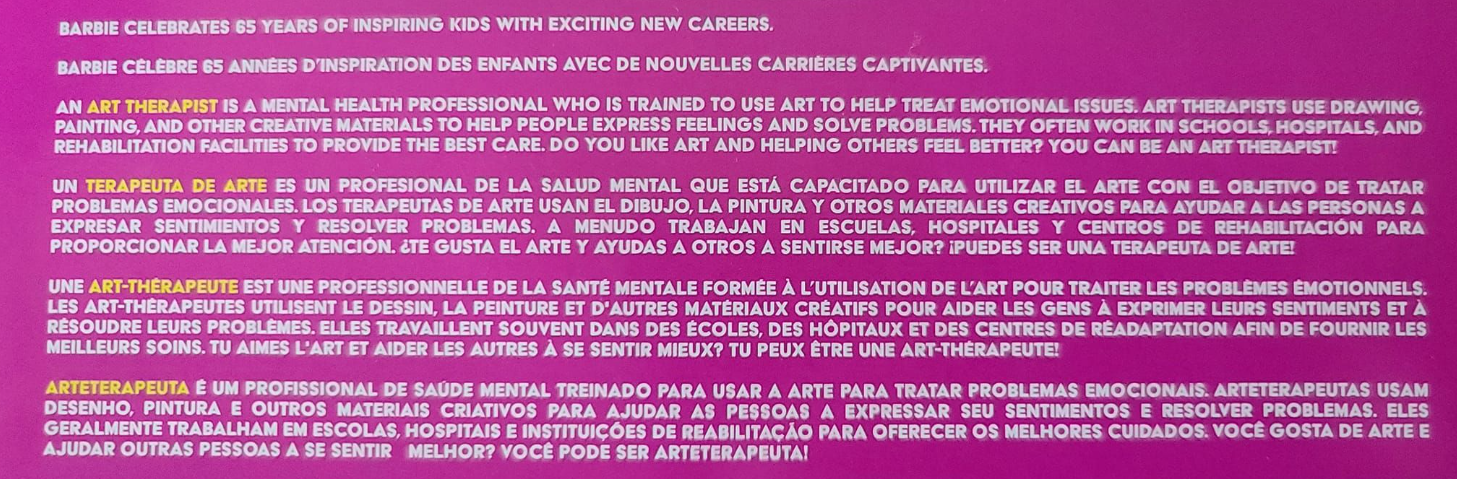
Apparently, Mattel consulted with AATA before creating her and they have a nice writeup on the back of the box about Art Therapy.


Thursday, June 17, 2021

Lacy Authors Article for Coping Magazine on How Art Therapy Helps People Cope with Cancer

I'm very honored to be asked by Coping with Cancer magazine to write an article for the May/June 2021 issue about using art as a way for survivors to cope with cancer. I'm thankful for the opportunity and I hope it helps others deal with this dreaded disease.

The Art of Coping with Cancer


Art Therapy Can Help You Process Your Emotions and Find Inner Healing

by Lacy Mucklow, MA, ATR-BC, LPAT, LCPAT, ATCS

What do you know about art therapy? Though art therapy is a lesser-known field, it is a growing form of psychotherapy. It is defined by the American Art Therapy Association as “an integrative mental health and human services profession that enriches the lives of individuals, families, and communities through active art-making, creative process, applied psychological theory, and human experience within a psychotherapeutic relationship.”

Studies have shown that art therapy has many benefits for cancer survivors, especially those currently undergoing cancer treatments like radiation and chemotherapy. Art therapy can help reduce symptoms of depressionanxietyfatiguepain, and distress in people diagnosed with cancer.

When you color, it allows your brain to focus on something creative. Plus, the repetitive action of coloring can be meditative and soothing.

Across the ages, the process of creating art has been recognized as being emotionally healing. It allows people to visually express their innermost being and can bring about calm, insight, and understanding. For many people, expressing themselves through art is easier than communicating with words. Art allows cancer survivors to focus on something other than their disease, helping them to process what is going on internally and then expressing it through their artwork.

Here are some creative ways you can use art to help you cope with cancer:

  • Coloring As a creator of adult coloring books, I have received several testimonials from cancer survivors who have said that coloring during their chemo treatments helped them relax. When you color, it allows your brain to focus on something creative. Plus, the repetitive action of coloring can be meditative and soothing. Other benefits of coloring include improved mood, reduced stress, and boosted creativity.
  • Mandalas Mandala is the Sanskrit word for “sacred circle.” Mandalas have been used in cultures around the world for centuries. Creating artwork using a circular guideline has meditative properties. Studies have shown that creating mandalas reduces stress and anxiety, and increases focus and concentration.
  • Zentangle® The Zentangle Method (zentangle.com) is an easy-to-learn, relaxing, and fun way to create beautiful images by drawing structured patterns, called tangles. Zentangle is thought to be a meditative method of art. Some cancer survivors have found that Zentangle helps them feel less anxious and more calm.
  • Collage For those who don’t feel particularly confident drawing, painting, or sculpting, collaging is a wonderful way to express yourself. To get started, simply grab some magazines, catalogs, or any other paper product containing words and images that you have around the house. Then, tear or cut out images and words that capture how you are feeling. Lastly, glue them onto paper in any arrangement that speaks to you. You can even augment your collage with your own writing or drawing. Finding images and words for your collage and reflecting on what they mean to you can help you process your emotions, discover things you didn’t know about yourself, and even communicate to others things that may be difficult to verbalize.

If you are interested in learning more about how art therapy can help you cope with cancer, ask your healthcare provider to refer you to art therapy services in your area or online. Art therapists work in treatment centers with cancer survivors and their families, as well as in groups for people who are recently diagnosed with cancer, currently undergoing treatment, or who have entered survivorship.

If a professional art therapist isn’t available in your area, pursuing art on your own can still provide some therapeutic benefits. Any of the techniques listed above are a fantastic way to get started.


Lacy Mucklow

Lacy Mucklow is a licensed, board-certified art therapist who has been practicing in the Washington, DC, area since 1999. She has published seven books and has released one relaxation album, with a second album currently in production. She is also a thyroid cancer survivor.

This article was published in Coping® with Cancer magazine, May/June 2021.

Friday, November 20, 2020

Art Therapist Features Work with Vocational Religious

Art therapist at the Saint Luke Institute, Nancy Parfitt Hondros, writes a feature about art therapy, how the creative outlet through art therapy aids in healing, and includes a case study of how art therapy helped a nun through her issues and allowed her to open up and trust more. Check out this great piece highlighting art therapy and how it can be used in so many ways! 


The Power of Creativity in Healing 
LukeNotes, Fall 2020 

Self-awareness is a foundational element of both mental and spiritual health. At times we find we are just going through the motions of everyday life. When on autopilot, we are not always conscious of the choices we make, how we respond to others, or the negative thoughts that occupy our minds. 

In real terms, this might mean praying without confidence or intention, hurting a colleague’s feelings, or abusing food or a substance to manage anxiety or sleeplessness. Choosing to look at what is underneath our thoughts, feelings, and actions requires courage and forms the basis for an authentic relationship with God, self, and others. 

Fear can also drive us to hide our real selves, so we smile when we are sad or ignore a family member when angry. The self we often share with others may only be a small portion of who we really are. When we become well-practiced at sharing only our external mask we may lose touch with the fearfully, wonderfully made being created in God’s image (Psalm 139:14). 

Art therapy is one tool that helps us gain insight into our personality, motivations, and behaviors. The focus is on the individual expressing his or her inner world. It is introspective. The art makes visible what is unseen or unacknowledged. Creativity can lead to greater self-awareness, helping us perceive the world in new ways, find hidden patterns, and make connections between seemingly unrelated experiences. 

By engaging our imagination, we can learn to take risks, ignore lingering doubts, and face our fears. Creativity’s therapeutic value lies in its ability to bypass the patterns of intellectualization and rationalization that undermine healthy thinking and decision-making. 

Foundations of Art Therapy 

Art therapy encourages people to convey and understand emotions through artistic expression such as collage, painting, sculpting, or poetry. At Saint Luke Institute, this specialized therapy offers each client a permanent and tangible record of their experience. As a primarily non-verbal intervention, art therapy allows images to present themselves and open the door to thoughts, feelings, and memories previously unexpressed, thus opening a path to verbal expression. These visual or sensory images accessed through a creative process support the expression of suppressed experiences for which words are inadequate (Naumberg, 1987). 

A range of materials are used for creative expression, but two mainstays are collage and mask making. Collages create a picture from seemingly disparate published images. They are an introduction to art therapy and provide an opportunity for creative problem-solving by fully activating the logical and creative sides of the brain. The artist has control of the process with support from peers and the art therapist. This sense of control is important as a client becomes acclimated to residential treatment. Clients are often surprised when their selected imagery moves emotions or experiences from the unconscious to the conscious. 

Mask making brings order to chaotic thoughts, feelings, and experiences and serves as a container for expression. Through the mask, the client artist acknowledges how he presents himself to others compared to how he feels on the inside. Masks are frequently shared with the primary therapist and often serve as a starting point for individual and group therapy sessions. 

Stages of Change in Art Therapy 

Clients often express an initial resistance to art therapy, as they may lack experience with painting or collage making and feel uncomfortable. Many clients protest, “I can’t draw,” or “I’m not an artist.” Gradually, this initial reluctance yields to an exploration of life experiences, such as parental alcoholism or divorce, and hurtful incidents, such as childhood bullying or peer rejection. 

Throughout the art therapy process a client’s knowledge base increases as she shares the meaning behind her creative projects and receives both critical feedback and affirmation from peers. As clients begin to relate to each other’s experiences, closer bonds are formed within the group. In time, clients connect their reactions to current life situations and how these interactions relate to foundational life experiences. 

As this awareness develops, clients become leaders in art and other therapy groups, serving as a role model to new members, thus perpetuating the circle of healing. The clinical team may recommend individual art therapy to support this deeper exploration of issues. Through group or individual art therapy many clients discover creativity as an essential tool for self-care. In preparing for discharge, clients formulate a Continuing Care Plan with their therapist that articulates several strategies and concrete actions for maintaining health after residential treatment. Ultimately, Saint Luke Institute clients are empowered to maintain their recovery and health using tools such as art, mindfulness, prayer, and 12-step programs. 

Naumberg, M. (1987). Dynamically Oriented Art Therapy: Its Principles and Practices. Chicago, IL: Magnolia Street Publishers. 

Nancy Parfitt Hondros, MA, ATR-BC, LGPAT, LGPC, is an art therapist at Saint Luke Institute in Silver Spring, Maryland. 

The Power of Creativity in Healing: Case Study 
Lukenotes, Fall 2020 

Sister Cecilia was raised in a small Polish town but often felt like an outsider as the only girl of nine children. Her father regularly drank to excess and was emotionally and verbally abusive. Her mother cowered from her husband’s anger and did not intervene for the children. Bullied in school, Sister Cecilia again felt like an outsider of little worth. As she had learned not to depend on her parents, so she also distrusted other people. This wariness eventually affected her relationships with community members and co-workers, leading to frequent angry outbursts, biting comments, and attempts to control people and situations. 

As a child, Sister Cecilia visited the nuns at her church, with whom she felt affirmed, to escape family tensions and bullying. She flourished in this spotlight and went on to attend the university, where she built friendships and had academic success. Responding to God’s call, she entered the convent after graduation. During initial formation, her anxiety increased, and her self-esteem plummeted when she heard her formators’ guidance as criticism. Despite these issues, she professed final vows and enjoyed her work as a nurse at the order’s hospital. She returned to school, earning a degree in social work, and began working as a hospice counselor. 

Sister Cecilia felt rewarded by her work with hospice patients and their families. Positive feedback from her patients increased her self-esteem. 

However, the hospital staff had a different response to her. They resented Sister Cecilia when she challenged the quality of their patient care and publicly criticized the staff. Angered by her interference, the staff asked for her removal. Instead of taking this permanent action, Sister Cecilia’s superior counseled her about her interference and negative exchanges with the staff. 

In the short term, Sister Cecilia responded to the feedback and tried to adjust her exchanges with coworkers and community members, but the problems resurfaced as she grieved a patient and family member’s death. This led to her reassignment to an independent hospice facility. Unfortunately, Sister Cecilia’s superior received new complaints about her interactions with others. A more significant intervention was needed. 

A New Beginning 

The Mother Superior recommended an evaluation at Saint Luke Institute in the United States in response to Sister Cecilia’s difficulties with interpersonal relationships. Sister Cecilia felt concerned about travelling outside of her homeland but was relieved to leave the conflict of community life. She hoped that this opportunity would lead to understanding her impatience and irritation. She knew of other sisters who had been referred to Saint Luke Institute; they returned to community life with an inner calm and spoke positively of their experience. She wondered if the same could be true for her.

When she arrived at Saint Luke Institute, a team of clinicians listened to Sister Cecilia’s personal history and completed clinical, psychological, and spiritual assessments. These provided the team with a full picture of Sister Cecilia’s life experiences and a deeper understanding of her needs. The evaluation team concluded that the women’s residential program (Talitha Life) would best support Sister Cecilia as she addressed past wounds. 

The Shift 

Sister Cecilia loved art, but she questioned art as a form of therapy. She discovered that her worry lessened as her art began to speak for her, especially as she was initially uncomfortable conveying her thoughts and feelings in English. During one session, she expressed her self-image through a mask; it was blank on the outside with a big smile on the inside. 

As she shared her mask with her peers, they questioned the mask’s message and her attitude within the group. They voiced their fear of her harsh comments and her reluctance to fully engage in the group process. Sister Cecilia revealed to her primary therapist how hurt she felt by the feedback. As they explored her hurt feelings together, the therapist helped her reflect on how their response paralleled the comments from her community members and coworkers. 

Gradually, as she poured her energy into the art therapy sessions, Sister Cecilia’s attitude changed. Her irritation, mistrust, and anger began to subside, and she gained the self-awareness to accept her peers’ constructive feedback, recognize that it was not connected to previous wounds, and offer feedback with kind assertiveness. Sister Cecilia realized how art therapy helped her safely voice her challenging feelings, thoughts, and experiences. With the clinical team’s approval, she began individual art therapy.

The art therapist planned individual sessions to address Sister Cecilia’s self-criticism, need for control, and anger. On a weekly basis Sister Cecilia was asked to identify positive actions and thoughts that increased her self-worth. To prepare for discharge, Sister Cecilia created a collage reflecting her hopes for her return to community identifying the recovery tools best suited to support her healthy reintegration into community life. 

For confidentiality, reasons, names, identifying data, and other details of treatment have been altered.

Tuesday, November 17, 2020

Art Therapist Creates Colorful Psychoeducational Posters

My art therapy colleague Melinda has been creating psychoeducational posters with her art and lettering skills. These are wonderful and I wanted to share them in case you find them helpful.