I saw this and did have to chuckle. I don't know if other artists have heard this a lot, but I actually hear it all the time in art therapy sessions. The nice thing about art therapy is that you don't have to be an artist to be able to benefit from it. I tell clients who say this to me, that stick figures - or even less - are fine, as long as they know what their artwork means and represents to them. :)
This is something that I tell clients often - that progress in therapy is not a straight line. There are ups and downs, two-steps-forward-one-step-back kind of progression. As you learn new coping skills, discover new things, gain more insight, and work hard in your therapy, the end result is reaching your goal at the top. But it's typically not that straightforward - and that's OK - and normal.
Happy to announce that I passed and now am an approved art therapy supervisor for the Kentucky license! Now I am officially an LPAT-S! 😁 Anyone need supervision?
Art Therapy Can Help You Process Your Emotions and Find Inner Healing
by Lacy Mucklow, MA, ATR-BC, LPAT, LCPAT, ATCS
What do you know about art therapy? Though art therapy is a lesser-known field, it is a growing form of psychotherapy. It is defined by the American Art Therapy Association as “an integrative mental health and human services profession that enriches the lives of individuals, families, and communities through active art-making, creative process, applied psychological theory, and human experience within a psychotherapeutic relationship.”
Studies have shown that art therapy has many benefits for cancer survivors, especially those currently undergoing cancer treatments like radiation and chemotherapy. Art therapy can help reduce symptoms of depression, anxiety, fatigue, pain, and distress in people diagnosed with cancer.
When you color, it allows your brain to focus on something creative. Plus, the repetitive action of coloring can be meditative and soothing.
Across the ages, the process of creating art has been recognized as being emotionally healing. It allows people to visually express their innermost being and can bring about calm, insight, and understanding. For many people, expressing themselves through art is easier than communicating with words. Art allows cancer survivors to focus on something other than their disease, helping them to process what is going on internally and then expressing it through their artwork.
Here are some creative ways you can use art to help you cope with cancer:
ColoringAs a creator of adult coloring books, I have received several testimonials from cancer survivors who have said that coloring during their chemo treatments helped them relax. When you color, it allows your brain to focus on something creative. Plus, the repetitive action of coloring can be meditative and soothing. Other benefits of coloring include improved mood, reduced stress, and boosted creativity.
MandalasMandala is the Sanskrit word for “sacred circle.” Mandalas have been used in cultures around the world for centuries. Creating artwork using a circular guideline has meditative properties. Studies have shown that creating mandalas reduces stress and anxiety, and increases focus and concentration.
Zentangle®The Zentangle Method (zentangle.com) is an easy-to-learn, relaxing, and fun way to create beautiful images by drawing structured patterns, called tangles. Zentangle is thought to be a meditative method of art. Some cancer survivors have found that Zentangle helps them feel less anxious and more calm.
Collage For those who don’t feel particularly confident drawing, painting, or sculpting, collaging is a wonderful way to express yourself. To get started, simply grab some magazines, catalogs, or any other paper product containing words and images that you have around the house. Then, tear or cut out images and words that capture how you are feeling. Lastly, glue them onto paper in any arrangement that speaks to you. You can even augment your collage with your own writing or drawing. Finding images and words for your collage and reflecting on what they mean to you can help you process your emotions, discover things you didn’t know about yourself, and even communicate to others things that may be difficult to verbalize.
If you are interested in learning more about how art therapy can help you cope with cancer, ask your healthcare provider to refer you to art therapy services in your area or online. Art therapists work in treatment centers with cancer survivors and their families, as well as in groups for people who are recently diagnosed with cancer, currently undergoing treatment, or who have entered survivorship.
If a professional art therapist isn’t available in your area, pursuing art on your own can still provide some therapeutic benefits. Any of the techniques listed above are a fantastic way to get started.
Lacy Mucklow is a licensed, board-certified art therapist who has been practicing in the Washington, DC, area since 1999. She has published seven books and has released one relaxation album, with a second album currently in production. She is also a thyroid cancer survivor.
This article was published in Coping® with Cancer magazine, May/June 2021.
My new album's Kickstarter is launched! Here is your chance to get the sequel album to Lavender Dreams...and more. The new album title and artwork are also revealed.
There are several reward levels you can choose from to meet *or exceed* the goal! You can also simply donate to support the project and sharing is a huge way you can show support.
This album is intended for clients to use as a meditative method or way to reduce stress and anxiety. It would be a great asset to your practice to use or make available to clients. Or, you might use it for yourself or gift it to a loved one.
Check it out and thanks in advance for your support! The deadline is September 1, 2021, so pledge soon!
I'm thrilled to be alerted that the UK newspaper, The Independent, has featured my and Angela's book "Be Stress-Free and Colour" in their "Best adult colouring books for unleashing your creativity" for 2021. Thank you for the honor!
I came across this chart that has a nice snapshot of ways you can manage stress in different areas of your life. I hope it is helpful for you, not just with this last year in mind, but for now and the future as well.
As some of you may have read before on my blog about color therapy and the psychology of color, I am excited to bring a guest blog post from Hana Rehman at Siege Media who writes about the importance of color in your environment, especially in your home décor. She pairs them with famous paintings with the calming palettes of color that may help soothe your home.
Calming Color Inspiration From
Famous Serene Paintings
Since we have all been spending more time at home in the past year, many of us have taken to redecorating our spaces. Interior decorating leaves so much room for creativity and self-expression, and it allows us to curate our homes with artful colors and décor pieces that inspire us.
It can be difficult to choose the best colors for your furniture, home décor, and accent pieces. However, if you’re interested in calming interior design palettes, you can learn more about some of the most soothing colors below through famous paintings that incorporate them. Then, take a look at the décor ideas paired with each painting to envision how each palette can benefit your environment.
Blue
Blue is thought to be one of the most calming colors. Soft blues evoke feelings of contemplation, depth, and gentleness. They bring to mind both water and sky. Blues make for beautifully serene spaces, and are great options for paint colors and furniture pieces.
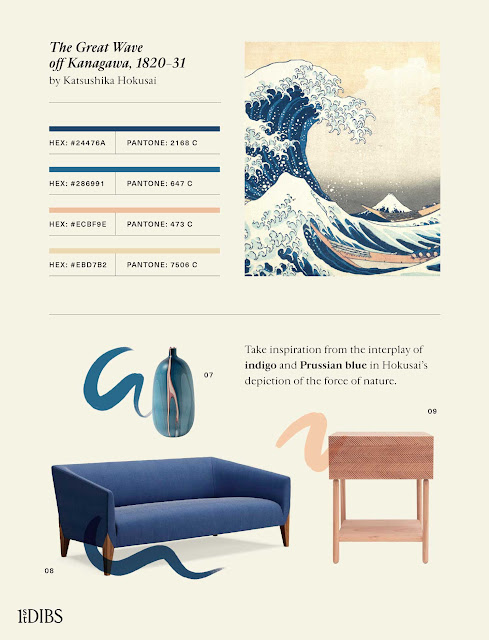
Hokusai’s famous woodblock painting The Great Wave off Kanagawa is an example of a painting with a pleasing palette thanks to its interplay of Prussian blue and indigo. It also incorporates a both pale yellow and a soft peach, serving as lovely compliments to the deep blue of the wave. Below you can find color and décor inspiration for incorporating the blues of this painting into your space.
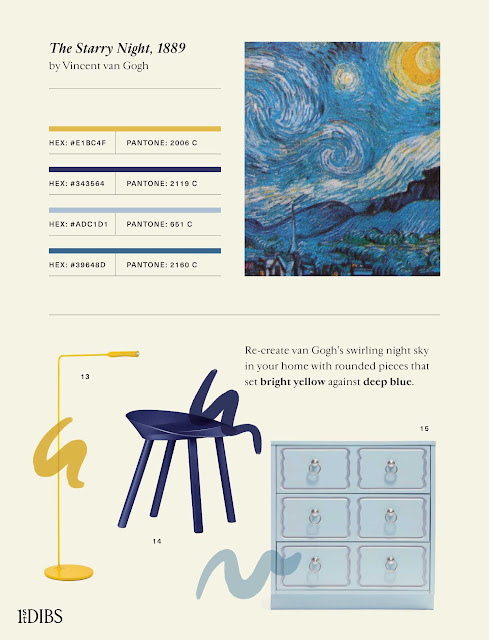
Van Gogh’s The Starry Night is another example of an iconic painting that incorporates blue. Van Gogh’s blue color palette is more lively and cosmic, broken up by specks of white and the bright yellow moon and stars.
Green
Green is often a calming color that reminds us of the peace found in nature. Imagining lush plants and dense forests can boost your mood and leave you feeling refreshed and relaxed.
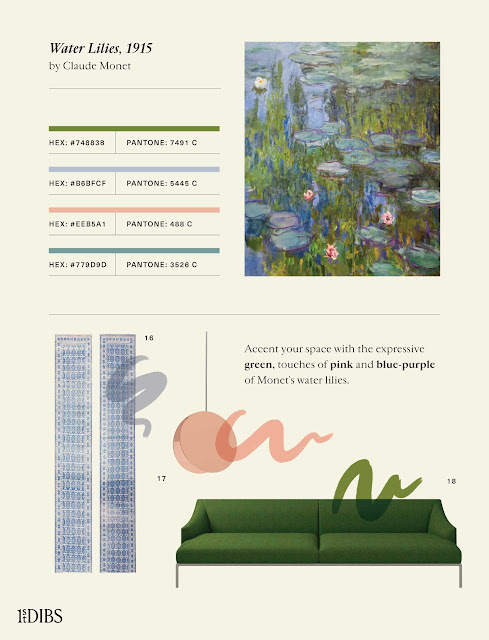
Monet painted hundreds of versions of the water lilies in his garden in Giverny, France. Like many of them, this one includes not only the blue of the water, but the deep greens of the vegetation in and around it. The painting’s color palette pairs this forest green with light pinks and purples. If you’d like to incorporate more green into your space, take inspiration from this masterpiece.
Yellow
Yellow is commonly associated with happiness, brightness, and warmth. It can be the perfect color to include if you would like to insert some energy into your space.
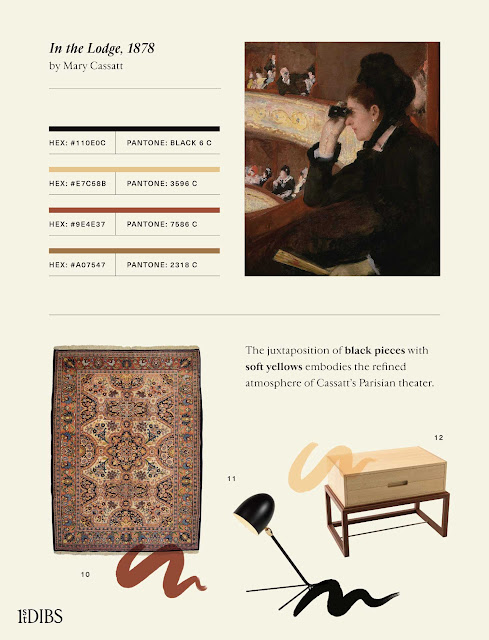
Mary Cassatt’s Impressionist painting In the Lodge weaves lovely golden-yellows with other warm-toned pigments, such as red and brown. Depicting a Parisian opera, the painting has an elegant and inviting atmosphere, one which you can capture at home by choosing traditional décor with a similar palette.
Observing art history’s iconic works can help you learn what kinds of calming color relationships speak to you most and choose which ones will best suit your living space. However, color inspiration is all around us—if you come across any scene that moves you, take note of the colors so you can recreate them at home or in your own works.
I was contacted a while back from a blogger to check out her site called "Creating My Odyssey" as she started to rebuild her creativity and talk about her mental health experiences. She gave me permission to share one of her entries...and perhaps we will see more of her in the future with collaborative blogs!
Dried Up
When I was depressed, I didn't want to create art, and I felt really disappointed as an adult when I felt that way. As a moody teen and early twenties at home, my mother would say: 'When you feel like that, you should paint.' I appreciate her sentiment now, but I just didn't want to paint, or do anything artistic. She couldn't possibly understand because she wasn't made that way, and she never would. At least she tried, bless her.
But, as an adult, although, when depressed, I didn't have the inner spark to want to create art. I was happy to write though. That was easy. I had had light hearted anecdotal articles published too. And I could write exactly how I felt, particularly if I felt embarrassed and couldn't verbalise what I was thinking, especially if the thought concerned Husband.
For instance, I felt sad about my hobby, the wild west. What? You may well ask. (See what I mean about embarrassment?) I wanted to be a cowgirl, a rough 'n tough, smokin', cursin', drinkin', sharp shootin' frontierswoman. Not stuck at home, looking after family. And I couldn't indulge that hobby much because I didn't have the energy and also I felt out of it because of anxiety among the more intense living history re-enactors who I was anxious may judge (some did, because I was portraying an unconventional female character).
Husband, insightfully, had said long ago when I began to head into depressions, that he could see my hobby rearing its head and being the subject of my depression. I'd be obsessed with something (I was good at being obsessed with things) and the wild west was it. I was writing my novel (about a cowgirl, naturally...) and that did help, although, of course, I wanted my book to be perfect. So, yes – that was a subject I had to write about to make sense of it.
I had considered art therapy. To paint, draw or collage how I felt. That didn't work either. I didn't want to do any of that. In order to express how I felt, I wrote. If I did do anything artistic, the subject would be anything I would normally do, nothing to do with depression or anxiety. That was what writing did for me.
But I did, so much, want to be artistic. And I wanted to be happy working in my 'creative space' (I was too embarrassed – that word again – to call it an art studio) in our conservatory. But I wasn't, for a long time, happy working there. I'd be okay for a short time, then depression would gradually swallow me up. So I wrote a lot, about lots, and not in my creative space. It wasn't until really recently that I began to feel good about being there and being creative. It's taken this long.
And I'm delving into dark, dusty corners and discovering artwork that I'd done in the dark and distant past and forgotten about. 'Wow! That's good!' I've thought, occasionally. No time for modesty, thank you. Anyway, shoving modesty aside, I'm uploading them onto Facebook and my blog and getting lovely responses to them. I'm also on the verge of recreating and organising my art area. And I'm beginning to get quite excited about it. A plant or flowers here, a water feature there, paints here, pencils there, sketchbooks here, boxed canvases there...
There is a website that I recently discovered, Blessing Manifesting.com, out of my home state that I find very helpful as a therapist. I enjoy using her brightly-colored artistic snapshots for mental health awareness, well-being, and self-care with patients and love that she makes them available to everyone. I just wanted to share a few of her latest offerings and encourage you to check out her website and FB page.
It was nice to come across this article, as it supports the effectiveness of art therapy for mental health treatment, especially for PTSD. I hope that the knowledge of art therapy continues to be known around the world as a integral treatment that is on par with or even exceeds the effectiveness of other therapies and should be included in all treatment settings.
While some wounds, like scars, are visible to everyone, other wounds go unnoticed, trapped inside the human mind. Post-Traumatic Stress Disorder (PTSD) is commonly found in veterans. Unfortunately, many veterans don’t get the treatment that they need to recover from this invisible struggle. Oftentimes, veterans are afraid to speak up about their PTSD because they worry about the mental health stigma that accompanies it.
Melissa Walker, an art therapist at the National Intrepid Center of Excellence (NICoE), explains that PTSD shuts down the speech-language area of the brain and renders sufferers speechless with fear. This is the reason why so many of our nation’s bravest return home and suffer in solitude. Recovering from PTSD involves working through these traumatic experiences that the sufferers don’t usually want to talk about. Thankfully, Walker explains that art therapy could be the perfect treatment for PTSD.
Art as a Psychotherapeutic Therapy
Walker says in her TED Talk, “Art Can Heal PTSD’s Invisible Wounds,” that “the process of art therapy bypasses the speech-language issue with the brain. Art-making accesses the same sensory areas of the brain that encode trauma. Service members can use the art-making to work through their experiences in a non-threatening way”. Additionally, the Art Therapy article, “Art Therapy Helping Veterans,” states, “Sometimes a person just can’t face the fact that it is okay to leave the baggage of war behind. By expressing how one really feels in the pit of the soul through the use of art, perhaps the mind can begin to let go of the trauma by transferring the images and ideas to another object of their creation through the medium of art”.
Furthermore, art helps veterans suffering from PTSD reintegrate their left side of their brain with their right side. By creating artwork, PTSD sufferers can slowly learn to voice their experiences and move passed their fears. At the same time, art also allows veterans take their mind off the things that are bothering them at the same time that they are confronting them.
PTSD and Mask-Making
While Walker explains that all types of art can benefit veterans with PTSD, she’s seen the most success in mask-making. Perhaps the reason that mask-making is such an effective therapy is that it allows veterans to give a literal face to their fears. Walker says, “when service members create these masks, it allows them to come to grips, literally, with their trauma. And it’s amazing how often that enables them to break through the trauma and start to heal”.
Additionally, the article, “Healing Invisible Wounds: Art Therapy and PTSD,” by Renee Fabian, also reaffirms the success of mask making. Fabian writes, “Clients examine feelings and thoughts about trauma by making a mask or drawing a feeling and discussing it. Art builds grounding and coping skills by photographing pleasant objects. It can help tell the story of trauma by creating a graphic timeline”.
One of the veterans that Walker worked with at NICoE says that after making masks, he was able to speak up about experiences that he hadn’t been able to talk about for 23 years. He explains, “You sort of just zone out into the mask. You zone out into the drawing, and for me, it just released the block, so I was able to do it.”
In a world where there are so many different treatment plans for physical wounds, it’s nice to know that people are working to help those with invisible ones. Art Therapy could be the perfect treatment for PTSD.
Madison Linnihan is a contributing editor with AmeriForce Media. She currently writes weekly blog posts for Military Families Magazine and The Reserve & National Guard Magazine, as well as contributing feature articles to both magazines. She is a senior at Troy University with an English Major and dance minor.
I read this interesting article about a CIA agent who received TBI treatment at the NICoE. What I also found encouraging was that he noted art therapy to be one of the most helpful aspects of his treatment.
"But what was most useful for me was the softer side of healing that is science based and proven to be effective in treating TBI.
A mask therapy program at the NICoE, in which TBI victims are encouraged by trained art therapists to express themselves by creating masks, helped me tremendously.
I put a great deal of thought and time into my mask -- a Superman-inspired one -- and wrote an accompanying poem. Both signified what my family thought of me for so long. A once invincible case officer on the tip of the spear for the US government, who served bravely and with distinction in Iraq and Afghanistan and other places I cannot name.
The mask was attached to a wooden plaque, with the background of the CIA seal cracked in half. It symbolized how I later had to fight some in the organization in order to obtain proper medical care. An ice pick is drilled through the mask as well, showing the headaches I still suffer from 24/7. Making this mask was a deeply cathartic experience for me, which -- along with talking to the resident chaplain and other talented mental health professionals -- has helped me begin to heal from the moral injury that I suffered. My kids recently sent me a text that stated "Dad, you are still our superman." I bawled like a baby."