This article was brought to my attention by a music teacher, which he saw in the National Education Association (NEA) magazine that highlighted the use of art therapy in the schools. When we were talking about our professions, he remembered reading this article and was kind enough to pass the magazine on to me (thanks, Russell!). Here is the article showing the growing importance of the use of art in schools with the ED/LD population. (click the link to download the PDF)
Friday, August 29, 2008


Sunday, June 01, 2008
WikiHow: How to Use an Art Journal
I happened to see this WikiHow entry featured on the front of my Google search page and thought it was cool. I thought I'd have to share it here...for yourself or for your clients to use!

Tuesday, April 08, 2008
Importance of Medical Art Therapy (and Arts in Health Care)
You Gotta Have Art
Patients Benefit From Creative Expression
Patients Benefit From Creative Expression
By Carol Strickland
Special to The Washington Post
Tuesday, April 8, 2008; HE01
As health-care costs skyrocket, a down-to-earth approach to healing is emerging, complementing high-tech medicine with high-touch arts.
The approach is based on the assumption that incorporating music, visual art, writing and performance into clinical care can increase feelings of well-being and even improve health -- an assumption that medical researchers are beginning to recognize the need to test with evidence-based studies.
Growing belief in the healing value of the arts was on display last month at a symposium at New York's Museum of Modern Art titled "The Value and Importance of the Arts in Health Care." Participants -- physicians, hospital administrators and artists -- were as upbeat as if they were promoting a miracle drug: Integrating the arts into health care is in vogue, said Leonard Shlain, a laparoscopic surgeon in San Francisco, "because it works."
The Society for the Arts in Healthcare, which sponsored the symposium along with MoMA and Vanderbilt University Medical Center, has seen its membership rise. As of 2006, the society estimated that more than half of 2,500 U.S. hospitals that were surveyed offer arts-based programs, said Anita Boles, the group's executive director.
Carol Herron coordinates an arts in medicine program at Texas Children's Cancer Center in Houston that involves visual artists, musicians, dancers, mimes, writers and puppeteers.
"We do children a disservice if all we do is treat the disease," she said. "We need to treat the whole child and the whole family."
And at New York University Medical Center, using art to reduce stress has become a priority, according to Marianne Hardart, director of creative arts therapies.
"There's not anyone it doesn't work with," she said, including adults, adolescents and younger children.
Not all institutions are willing to incorporate approaches of this kind, though, Hardart said. "In medical settings geared toward physical and chemical interventions, we're often considered an adjunct instead of an integrated piece."
That's partly because the research supporting these programs is slim.
Some of the documented benefits -- based largely on short-term appraisals of small numbers of patients -- include enhanced quality of life, patients' increased cooperation with painful procedures and helping staff understand a patient's point of view. Mounting evidence from the few early empirical studies also report reduced fatigue, depression, anxiety, pain and stress, which may boost the patient's immune system.
Letting Go of the Pain

Artwork can help medical staff perceive fears that patients sometimes can't express verbally. Matthew Gerson, vice chairman of the board of the Prevent Cancer Foundation, which funds Tracy's Kids, described a 12-year-old patient awaiting bone marrow transplant who made a puppet he called Dr. Bones. In the course of dramatizing a story, the child revealed his terror that his own bones would be removed. The art therapist was able to correct the misconception.
As part of a rehab team at NYU, art therapist Alice Landry works with adults who have suffered brain or spinal cord injury. A project such as woodworking or jewelry, she says, "creates a metaphor for them rebuilding themselves." Her patients demonstrate not only emotional but functional gains. After four weeks, a multiple sclerosis patient who initially couldn't pick up a bead was stringing beads and adding clasps, she said.
Fabien Navidi-Kasmai, 15, diagnosed with a form of Hodgkin's lymphoma when he was 11, illustrated his five-day course of chemotherapy at Georgetown: "I drew a picture of me getting hit by a truck," he said in a phone interview, "then I'd get up and get hit by a train. I'd get up again and be hit by a plane. It really helps to get those feelings out on paper." The lure of the art studio made him drag himself out of bed. "Unless you've been through it," he said, "it's difficult to grasp the concept that art has the power to make having cancer a good experience."
Uplifted Spirits
Aziza Shad, medical director of the pediatric hematology oncology unit at Georgetown, said the facility was designed around its open art studio. "The focus of our clinic is the art therapy program."
As soon as they sign in and before blood is drawn, children race to the art table. They forget they've come for examination, as they laugh, chat, draw or do clay work. Shad believes strongly in the program's benefits: "Those children who participate in the art therapy program do so much better physically."
Karen Robinson, who lives in Washington and whose son Max was 5 when he received a diagnosis of acute lymphoblastic leukemia, found the Georgetown clinic welcoming: "We knew that this was home," she said. "It helped us mind, body and soul."
Another Tracy's Kids program has opened at the Center for Cancer and Blood Disorders at Children's National Medical Center. Max Coppes, executive director of the center, said that once the art studio was installed, children began grabbing their IV poles and rushing over to work on their projects. "My prediction is, this will become a huge success," he said.
Besides providing feel-good activity, the arts can enhance a hospital's physical environment. Brigham and Women's Hospital in Boston spent more than $1 million to spruce up a 200-foot-long hallway its patients used when going to the Dana Farber Cancer Institute for treatment.
Estrellita Karsh, who originated the project (she is a former medical writer and the widow of the famed photographer Yousuf Karsh), said the passage used to be "traversed by very depressed-looking people, hunched over with their shoulders down." After installing a mural of 149 birds carrying medicinal sprigs, the corridor was renamed "the Bridge of Hope." "Nobody," Karsh said, "goes through with their head down now." One 3-year-old girl, bald from chemotherapy, used to be prodded along to her treatments. Now, the girl points to "her" bird, a scarlet ibis, and talks to it: "Are you a good girl?"
"There's no question there are numerous facets to caring and healing, and the physical environment is a critical one," said psychiatrist Gary Gottlieb, Brigham's president. "It has been shown that people's optimism, their mental outlook and their mood affect outcome in the treatment of chronic diseases and a number of cancers."
Anecdotes and Evidence
Some educators are schooling medical students not only in the art of medicine but also in the broader arts: drawing, art history and poetry. Edith Langner, faculty director of the Arts in Medicine Project at Columbia University Medical Center, takes second-year med students to MoMA and the Metropolitan Museum of Art, where she hones their observational skills. Looking at portraits trains the students to examine patients' faces, she says.
Yet resistance persists. Many doubt the humanities belong in medical education, and when they are included they're often marginalized rather than fully embraced. The field of art and health care, as William J. Ivey, former chair of the National Endowment for the Arts, put it, is "anecdote-rich and evidence-poor."
"If, on scientific examination," Ivey said, "our anecdotes and intuitions turn out to be correct, we can then -- with the evidence required -- move forward in policy areas."
Even a physician such as Coppes, who is convinced of the value of art therapy, explains, "I'm an academic, so if something is not demonstrated in a double-blind, randomized study, it doesn't exist."
Karsh, the medical writer, remains adamant in her faith: "Anecdotal accounts always seem to precede scientific corroboration," she said. ·
Carol Strickland is an art critic and medical writer based in New York. Comments:health@washpost.com.
Sunday, January 20, 2008
Art Therapy Outcome Studies
Here is a great resource to help undergird the importance of art therapy. This listing provides information of art therapy outcome and single subject studies that can help with research, grants, effects, and support for art therapy. Some topics included are ADD/ADHD, Asperger's, Geriatrics, Grief, Chemical Dependence, PTSD, Abuse, School, Traumatic Brain Injury (TBI), and Developmental Delay.
Sunday, January 06, 2008
Art Therapy: Tree Drawings

I came across this video of a person who video blogged their art journal of tree drawings over a period of time. I found this particularly interesting, especially since my art therapy master's thesis was about self-identity and self-concept as shown through tree drawings.
Art Therapy in the Netherlands
Sunday, December 02, 2007
Art Therapy: Be the Change You Want to See
Here is a video that Cathy Malchiodi premiered at the American Art Therapy Associations' 38th Annual Conference in Albuquerque this November. It is a very good film short to show some of the power of art therapy, used in Darfur.
Tuesday, September 18, 2007
Using Crayons to Exorcise Katrina
The New York Times featured an article on art therapy's significance in assisting children in coping and healing from Hurricane Katrina:
Using Crayons to Exorcise Katrina
By SHAILA DEWAN
BAKER, La., Sept. 16 — One of the most common images in children’s art is the house: a square, topped by a pointy roof, outfitted with doors and windows.
 So Karla Leopold, an art therapist from California, was intrigued when she noticed that for many of the young victims of Hurricane Katrina, the house had morphed into a triangle. “At first we thought it was a fluke, but we saw it repeatedly in children of all ages,” said Ms. Leopold, who with a team of therapists has made nine visits to Renaissance Village here, the largest trailer park for Katrina evacuees, to work with children. “Then we realized the internal schema of these children had changed. They weren’t drawing the house as a place of safety, they were drawing the roof.”
Countless articles and at least five major studies have focused on the lasting trauma experienced by Hurricane Katrina survivors, warning of anxiety, difficulty in school, even suicidal impulses. But few things illustrate the impact as effectively as the art that has come out of sessions under the large white tent that is the only community gathering spot at Renaissance Village, a gravel-covered former cow pasture with high truancy rates and little to occupy youngsters who do not know when, or if, they will return home.
Even now the children’s drawings are populated by alligators, dead birds, helicopters and rescue boats. At a session in May one 8-year-old, Brittney Barbarin, drew a swimming pool full of squiggly black lines. Asked who was in the pool, she replied, “Snakes.”
The drawings, photographs and sculptures, about 50 of which went on display Sunday at the New Orleans Museum of Art, are a good indicator of how children are coping, said Dr. Irwin Redlener, the co-founder of the Children’s Health Fund, which has provided mobile mental health clinics to some families along the Gulf Coast. The art also shows that the trauma did not end with the hurricane.
“The real prescription for these families is to get them back into a normal community,” Dr. Redlener said. “We’re treading water doing these things, when I’d like to take my prescription pad and write, ‘Home.’ ”
On Saturday a wild commotion greeted the arrival of the art therapists, who were handing out T-shirts and registering families for a bus trip to the museum the next day for the exhibition, “Katrina Through the Eyes of Children,” which runs through Oct. 7. The therapists asked the children to draw two pictures each, and then kept an eye out for indicators of deep disturbance, like a picture by Trinity Williams, 7, that showed a figure swimming with a shark. Turbulent blue lines covered the entire paper.
Trinity is an energetic child who likes to sing and dance, and play tricks like pulling her name tag off and plastering it across her mouth. Ms. Leopold coaxed her to sit at a picnic table and add things to the drawing that could help the swimmer: a pool float, an adult in a boat, a yellow sun. Trinity has been in treatment for hyperactivity since the storm, said Donna Azeez, who is rearing Trinity. When the art therapists visit, Ms. Azeez said, Trinity will be “a lot calmer, she’ll be smiling.”
Even the adults participate, drawing churches, front porches, trees and, in one session, a picture of the trailer park with one palatial house and swimming pool in its midst. Many, both adults and children, draw at a level that is years below what is expected at their age, partly as a result of traumatic regression.
On Saturday, Lashawn Wells, 13, presented a drawing of three stick figures in a scribble of gray water: his mother, sister and brother, their arms up in the air. “Where are you?” Ms. Leopold asked. “I don’t want to be in the picture,” Lashawn muttered. Ultimately, Lashawn added himself, a life jacket, a road for running away, and a bridge.
Ms. Leopold handed him a blank sheet of paper and asked what safe place was waiting for him on the other side of the bridge. “The Superdome?” Lashawn asked tentatively. “Reliant Center?” Eventually he changed his mind, deciding to draw a house, adding doors, windows, a dresser, and, with Ms. Leopold’s gentle urging, other things he wanted to feel safe, including a cellphone and a gun. The house was shaped like a triangle. Ms. Leopold said the triangle houses were not drawn solely by children who were rescued from rooftops. “This is the collective unconscious,” she said.
Unlike many who have tried to help Katrina evacuees, the art therapists have returned again and again, earning the trust of a community of about 400 families that feels isolated and forgotten.
They have taught the children to knit, furnished them with journals and digital cameras, even taken a lucky few to the Idyllwild Arts Summer Program in California. They have devoted considerable time to letting the children construct and decorate houses and cities, to literally rebuild.
One elaborate three-dimensional version of New Orleans, a community effort built of cardboard boxes that included streets, a church and even a graveyard, was reduced to a soggy mess by a rainstorm. The next day the children began to rebuild.
Rosie O’Donnell’s For All Kids Foundation financed the first year of the therapy program; a recent $1 million grant from the country music stars Faith Hill and Tim McGraw will help it continue. Art has piled up in a storage unit in nearby Baton Rouge, La., and in the garage of Leo Bonamy, a project volunteer.
Ms. Leopold said that there are signs of recovery in the children’s drawings, but not many. When the American Art Therapy Association held its annual convention in New Orleans last year, she said the organizers asked for examples that were colorful and hopeful. “We didn’t have any,” she said.
But there are subtle indications: In 2005 Cheryl Porter, 17, drew the car in which she and her family escaped. In Saturday’s picture the car was safe in a garage. “If I don’t draw, I get in trouble,” Cheryl said.
On Sunday three buses filled with families from Renaissance Village headed for the museum, where they would be met in the large, columned lobby with lemonade, cookies and a jazz piano player. As the bus neared the museum, 7-year-old Corielle Mutin spotted Bayou St. John, where two kayakers paddled in the afternoon sun. “I’m scared,” she said, “of the water.”
Monday, August 27, 2007
2007 National AATA Conference
 38th Annual American Art Therapy Association Conference
"The Art of Connecting: From Personal to Global"
Hyatt Regency Hotel
Albuquerque, New Mexico
November 14-18, 2007
~~Click here to register online~~
~~Click here to see the program schedule~~
FEATURED SPEAKER
Thursday, November 15, 10:30 - 11:30am
Thursday, November 15, 10:30 - 11:30am
Meinrad Craighead, MFA
Threshold: An artist's entry into creativity
The spiritual journey is an experience of birthing into creativity. Using slides of her own artwork as well as that by artists throughout history, Meinrad Craighead will midwife an entry into the mystery of creating. Her talk will illuminate the threshold as it marks moving toward and into the place of the unknown. The threshold is the pulling aside of the curtain—having the energy and courage to pull aside the curtain to search inside for images already present.
FEATURED SPEAKER
Friday, November 16, 8:45 - 9:45am
Friday, November 16, 8:45 - 9:45am
Alexander Shaia, PhD, ISST/STA, LPC
All Journeys-One Journey
All Journeys are One Journey. No matter if it is our clients or ourselves, in art and in life, there is a progression of inner landscapes. The four-fold journey involves climbing the highest mountain, crossing the storm-tossed sea, resting awhile in a glorious garden and, possibly walking along a road of riches. This sequence is universal, sequential, invariable, and ever recurring. Using visuals, personal and client stories, and poetry, Dr. Shaia will take us through the archetypal life journey, "Quadratos."
FEATURED SPEAKER
Saturday, November 17, 8:30 - 9:30am
Saturday, November 17, 8:30 - 9:30am
Thomas Singer, MD
Image and Complex in the Collective Psyche
Complexes are psychic structures that are a common cause of psychological distress. They most frequently cluster around parental images as well as issues such as power, inferiority, and sexuality. The emerging theory of cultural complexes, a new addition to Jung's original notion of complexes, takes complex theory beyond the personal to the level of the group psyche. Cultural complexes frequently constellate around group historical experiences of trauma, dislocation, and discrimination. They often reveal themselves in the art and media of a particular culture, since images can "carry" complexes, and their effects can be recognized in the psyche/behavior of both groups and individuals. Differentiating cultural complexes from personal complexes is not only of theoretical value, but can be useful in clinical practice with clients in group and individual sessions. In today's world, recognizing images as carriers of cultural complexes can be helpful in gaining perspective on cross-cultural, political, and other conflicts.
Sunday, April 01, 2007
The Art Therapy Connection
Monday, January 01, 2007
CareerBuilder.com Names Art Therapy as a Top 10 Job for 2007
10 Hot Jobs for 2007
Candace Corner, CareerBuilder.com writer
Candace Corner, CareerBuilder.com writer
As the world continues to advance and change technologically, we are living longer, retiring later and pursuing higher education at a higher rate than generations before us, and the employment market is changing right alongside us.
According to the Bureau of Labor Statistics, technology is just one of the few factors in determining what's going to be the next great gig out there. Demographic shifts, legislative changes, business trends and consumer behavior also factor into what's going to be the next big thing and what's going to be history.
Here are some of today's jobs that are on the cutting edge:
What they do: Treat physical, mental and emotional disabilities through art expression.
What you need: A master's degree in art therapy with completed curriculum under the American Art Therapy Association's educational standards. To be a registered art therapist, 1,000 hours of direct client contact must be reached after graduation.
Friday, December 15, 2006
Using Art Therapy with Eating Disorder Clients
The documentary "THIN" takes us inside Renfrew Center, a residential facility for the treatment of women with eating disorders in Pennsylvania and other locations. "THIN" premiered Tuesday, November 14th, 2006 at 9PM EST on HBO. Watch the clip of art therapist Karen Polin working with a client on body image distortions below.
Monday, September 11, 2006
Healing Visions
Monday, May 22, 2006
2006 National AATA Conference
 AATA 37th ANNUAL CONFERENCE
"Reaching Out & Rebuilding Our Communities"
November 15-19, 2006
Riverside Hilton
New Orleans, LA
~~CLICK HERE TO SEE THE PROGRAM SCHEDULE~~
The 37th annual AATA Conference will be held November 15-19, 2006 at the Hilton Riverside in New Orleans, across the street from Harrah's and a short "Mississippi Riverwalk" from the legendary French Quarter!
As you may already know, this year's conference theme, "Reaching Out and Rebuilding Our Communities," has been specially selected out of respect for the city and its inhabitants that will host hundreds of art therapists this year. Come and learn from the outstanding clinicians and others from around the world how art therapists build and maintain communities at home, work, and in their professional lives. In many ways, this will be an historical conference year you don't want to miss!
Two Exciting Keynote Presentations!
Elizabeth Birch, spokesperson for the Rosie O'Donnell Foundation, will be speaking about building communities and Rosie O'Donnell's project funding art therapists and art supplies to work in the hurricane devastated areas from New Orleans to Baton Rouge. Art therapists from around the country have participated in one and two week visits to these areas to provide art therapy for displaced families. In the next weeks, a CNN documentary about this project will be filmed. Following her keynote, she will lead a panel related to the topic.
Bessel A. van der Kolk, M.D., internationally renowned expert in trauma treatment, theory and research will be part of the AATA's Research Committee's "Conference within a Conference." In addition to participating in this group of research presentations, panels and roundtable discussion, the eminent Dr. van der Kolk will provide a plenary talk and workshop.
Thursday, February 23, 2006
Art Therapy with Tracy's Kids wins fundrasing award!
There was a fundraiser held at the E Street Cinema in DC to support Tracy Councill's art therapy program for children with cancer at Georgetown University Hospital's Lombardi Cancer Center, called Tracy's Kids. Congratulations to Tracy! Watch the video below (or click here).
Tuesday, January 24, 2006
Read about Art Therapy in the News
Thursday, January 05, 2006
Artwork of a Fellow Art Therapist...and Friend

One of my friends from graduate school is an accomplished artist, showing her artwork in many places including New York, Seattle, and Israel. She has a website featuring her artwork, and I wanted to share it with you.
Wednesday, October 12, 2005
2005 National AATA Conference
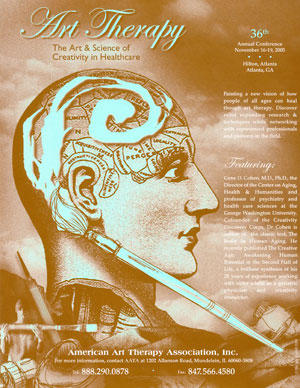
This year, the 36th Annual Conference will be held in Atlanta, GA, at the Hilton Atlanta from November 16-19. This year's theme is "The Art of Science of Creativity in Healthcare."
Click here to read this year's program, and click here if you would like to register.
Click here to read this year's program, and click here if you would like to register.
Wednesday, October 05, 2005
Coping with Hurricane Katrina
Art therapy has been particularly helpful in processing trauma, one of the most recent events of which has been Hurricane Katrina. This article mentions the value of using art therapy, as well as other modalities (i.e., play & drama therapies), with children and teens to deal with the aftermath of Katrina. Cathy Malchiodi writes about how art therapy is particularly helpful in promoting trauma recovery with children, regardless of the degree. (click on the .pdf version to see the artwork) As she states:
"Art Therapy can be beneficial to people of all ages, but it is especially useful for children. Art is a natural form of communication for children because it is easier for them to express themselves visually rather than verbally. This is particularly true for children who have experienced a traumatic event, such as Hurricane Katrina, or other natural or man-made disasters."AATA has asked for art therapists to assist Hurricane survivors in the Gulf region to cope more effectively the trauma that occurred during and after the hurricane. Art therapy has become more well known as an effective tool in helping process and desensitize the tragedies that occur in the lives of people, particularly in the wake of large disasters such as the Asian Tsunami and Hurricane Katrina. Best of wishes to the therapists and the survivors as they work together towards healing.
Saturday, October 01, 2005
AATA E-Newsletters
August 2005, Volume 2.5
August 2005 (Special Edition)
September 2005 (Special Edition)
October 2005, Volume 2.6
December 2005, Volume 2.7
February 2006, Volume 3.1
March 2006, Volume 3.2
May 2006 (Special Edition)
June 2006, Volume 3.3
September 2006, Volume 3.4
December 2006, Volume 3.5
March 2007, Volume 4.1
May 2007, Volume 4.2
August 2007, Volume 4.3
January 2008, Volume 5.1
Tuesday, September 27, 2005
Education & Professional Credentials
Bachelor of Arts in Psychology with Studio Art Minor
Oklahoma State University, 1997
Master of Arts in Art Therapy
George Washington University, 1999
AATA Professional Member, since 2001
Registered Art Therapist (ATR), 2005
Board Certified (BC), 2006
Oklahoma State University, 1997
Master of Arts in Art Therapy
George Washington University, 1999
AATA Professional Member, since 2001
Registered Art Therapist (ATR), 2005
Board Certified (BC), 2006
Monday, June 06, 2005
Art therapy aids young tsunami victims
Art therapy aids young tsunami victims
Group helps children regain some control in their lives
Group helps children regain some control in their lives
The Associated Press
updated 12:46 p.m. ET, Mon., June 6, 2005

Dr. Jennifer Baggerly, seen during a play therapy session with children in Colombo, Sri Lanka, is part of the Association for Play Therapy team.
updated 12:46 p.m. ET, Mon., June 6, 2005

Dr. Jennifer Baggerly, seen during a play therapy session with children in Colombo, Sri Lanka, is part of the Association for Play Therapy team.
Dr. Jennifer Baggerly via AP
TAMPA, Fla. - One child’s drawing shows a swirling sea that has engulfed houses, trees and people, their arms outstretched in a final attempt to save themselves from a deadly tsunami.
Another child paints a darker scene in watercolors — muddy swirling waves and hauntingly detailed faces of drowning victims.
The images, even though disturbing, were therapeutic for the children who watched their families and neighbors being swept away during the Dec. 26 Asian disaster.
“The images get stacked up in the children’s mind if they don’t get the support to express it,” said Jennifer Baggerly, a professor who specializes in play therapy for traumatized children.
Baggerly, 42, has coaxed fear and anxiety out of the littlest victims of natural and manmade disasters. And, she recently used art to help comfort young tsunami victims.
'Toys are medicine'
Earlier this year, the University of South Florida professor joined a team of therapists sent to Sri Lanka by Operation USA, a Los Angeles-based international aid organization.
The group traveled to Trincomale, visiting an orphanage and refugee camps for minority Hindu Tamils who have been forced from their homes in a long-running civil war. The orphanage was located near a beach, still scattered with shoes and clothes from tsunami victims.
“You see women’s saris on the beach. It was a constant reminder of the tragedy,” Baggerly said.
Besides therapists, the organization has sent several shipments of toys and art supplies to Sri Lanka and other countries hit by the tsunami. In a disaster of such magnitude, officials said, it is easy to overlook children’s unique needs.
“We just basically say that toys are medicine for children, period,” Operation USA President Richard Walden said. “Whether it’s a giant box of a thousand Frisbees or a couple of hundred tennis balls. You show up in some of these places and they have nothing to play with.”
Some studies have indicated that a child’s developing brain can suffer permanent damage if anxiety goes untreated. While the research into childhood trauma is complicated, therapy is not. Children only need to play and learn new ways to communicate their fears, Baggerly said.
While in Sri Lanka, she taught the young victims yoga techniques to deepen their breathing and calm their nerves, and a “butterfly hug,” where children cross their arms in front of their chest and tap their fingers. The movement engages both sides of the brain and can snap a child consumed with a disturbing past back into the present, she said.
More importantly, the team of therapists taught the children to play again — the start of bringing the children out of their shells.
“They were afraid mainly of playing outside because they thought another tsunami was coming,” Baggerly said.
Baggerly and other volunteers also put on a puppet show and told a story about animals that had something bad happen to them. Working through translators, they addressed the children’s fears.
The group explained it had been an earthquake which had caused the giant wave. Many of the youngsters had believed they were responsible for the tsunami or that they were being punished by a higher power.
“They were saying, ’Did the tsunami come because I had bad thoughts?”’ Baggerly said.
Regaining control
Baggerly, 42, has been working with traumatized children for more than a decade, focusing on those who lived in homeless shelters. After the Sept. 11, 2001, attacks, she turned to helping children who had survived catastrophes and training emergency workers in dealing with young disaster victims.
In Florida, Baggerly helped young hurricane victims cope with the devastating aftermath of last year’s storms. Traveling to areas hit hard by Hurricane Charley, Baggerly worked with children at an emergency aid center.
The only entertainment was a television set up in a corner with some folding chairs in front of it. The youngsters had no toys, no organized activities and plenty of nervous energy, fear and anxiety.
Baggerly brought art supplies for the children to create signs and drawings designating the corner of the center as their personal space. The activity allowed them to regain some control when their world had been turned topsy-turvy, she explained.
For children on both sides of the world, she said, the best way to cope can be found in the trappings of childhood — a crayon, a piece of paper, a puppet show.
“The procedures you use for trauma after a hurricane are similar to the ones you use after a war,” Baggerly said. “You try to help them be optimistic and focus in the here and now.”
Thursday, May 05, 2005
My Artwork
As an art therapist, some people want to view samples of my artwork. Here are a few pieces from over the years.


Subscribe to:
Posts (Atom)